Tech deals and royal pageantry: What’s at stake during Trump’s second official visit to the U.K.
[ad_1]
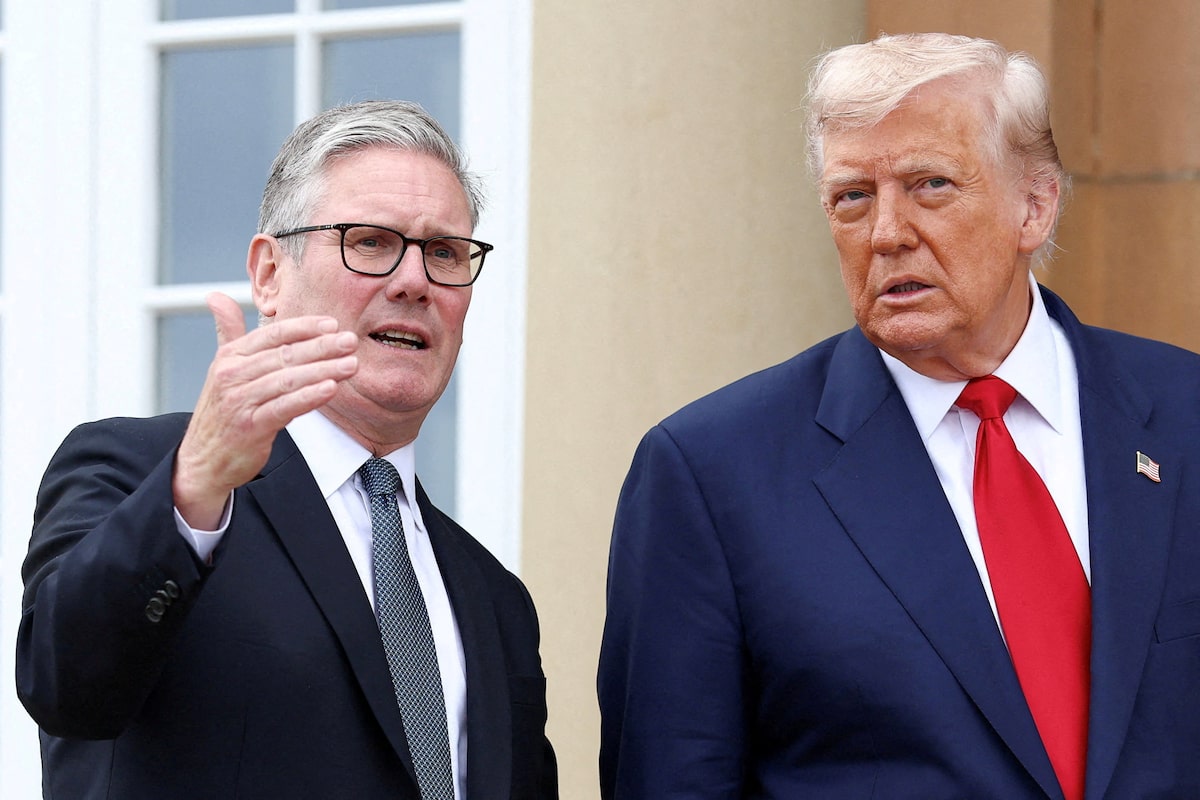
President Donald Trump meets with British Prime Minister Keir Starmer at the Trump Turnberry golf course in Scotland in July. President Trump arrives in Britain late Tuesday for his second state visit.Evelyn Hockstein/Reuters
U.S. President Donald Trump arrives for his second state visit in Britain late Tuesday, where deals worth more than US$10-billion are expected to be announced, according to U.S. officials.
Business will get underway Wednesday morning, when Mr. Trump will meet with British Prime Minister Keir Starmer, who is facing public discontent and days ago fired his ambassador to the U.S. over ties to convicted sex offender Jeffrey Epstein.
Britain prepares for Trump’s arrival with pomp and protests
U.S. and Britain to announce tech, nuclear energy deals during Trump visit
During Mr. Trump’s two-day visit, the United States and Britain are poised to strike agreements on technology and civil nuclear energy. The U.K. also hopes to finalize steel tariffs under its current trade deal with the U.S.
Here’s a look at the current state of the U.S. trade relationship with the U.K. and the companies expected to announce investment deals.
Souvenirs portraying U.S. President Donald Trump, the late Queen Elizabeth II and Britain’s King Charles in a shop in Windsor, ahead of President Trump’s state visit.Hannah McKay/Reuters
Where does the U.S.-U.K. trade deal stand?
Mr. Trump and Mr. Starmer will seek to finalize a trade agreement struck during the G7 summit in Kananaskis, Alta., which solidified a framework first negotiated in May.
Under the finalized version, the U.S. will cut its tariff on British cars from 27.5 per cent to 10 per cent, but only on the first 100,000 vehicles a year. Mr. Trump has also agreed to eliminate the 10-per-cent tariff on imports of British-made aerospace parts such as jet engines. In return, the U.K. has committed to easing import restrictions on U.S. beef and ethanol.
Mr. Trump did not lower tariffs on British steel and aluminum, which the earlier framework called for, maintaining a 25-per-cent duty on imports. In June, Mr. Trump raised that tariff to 50 per cent for most countries, but not the U.K.
Other British exports to the U.S. also continue to be subject to a baseline tariff of 10 per cent. Prior to Mr. Trump launching his global trade war in April, U.S. duties on British imports were around 3 per cent.
What’s at stake for the two countries?
The U.S. is the U.K.’s largest trading partner, accounting for nearly 18 per cent of the country’s total trade at the end of the first quarter, according to the U.K. Department for Business and Trade. Starmer wants to pitch Britain as a destination for U.S. investment, closely aligning its financial services, tech and energy sectors with larger peers to try to drive much-needed economic growth at home.
The U.K. trade agreement was the first major announcement by Mr. Trump since he unveiled sweeping tariffs in April on imports from dozens of countries, only to back off on some and change others. The White House said at the time that it “sets the tone for other trading partners to promote reciprocal trade with the United States.”
Britain and the U.S. enjoy a relatively balanced trade relationship, with neither country running a surplus in the exchange of goods. The trade in goods is worth about £113.7-billion (US$210.4-billion) annually. However, trade in services – such as financial services and tourism – is far larger at £179-billion, and Britain has a surplus with the U.S.
What is the state of U.S.-U.K. relations?
Three centuries after Britain’s kings and queens gave up political power and settled for the role of ceremonial head of state, the royals remain a robust instrument of “soft power,” which the elected government uses to reward friends and wring concessions out of reluctant allies.
State visits are the monarchy’s ultimate tool, with world leaders vying to get the full royal treatment.
The unprecedented nature of the invitation, along with the expectation of lavish pomp and pageantry, holds dual appeal to Trump. The Republican President has glowingly praised the King’s late mother, Queen Elizabeth II, and spoken about how his own Scotland-born mother loved the Queen and the monarchy.
U.S. flags and British flags in front of Buckingham Palace ahead of U.S. President Donald Trump’s visit in London on Tuesday.Jaimi Joy/Reuters
Preparations for the visit, however, have been ruffled by political turmoil in Starmer’s centre-left government. Last week, Starmer sacked Britain’s ambassador to Washington, Peter Mandelson, over his past friendship with convicted sex offender Jeffrey Epstein.
Mandelson had good relations with the Trump administration and played a key role in securing the U.K.-U.S. trade agreement in May. His firing has put Epstein back in British headlines as Trump tries to swerve questions about his own relationship with the disgraced financier.
Mandelson’s exit came just a week after Deputy Prime Minister Angela Rayner quit over a tax error on a home purchase. A senior Starmer aide, Paul Ovenden quit Monday over tasteless text messages he sent years ago. Fourteen months after winning a landslide election victory, Starmer’s position at the helm of the Labour Party is fragile and his poll ratings are in the dumps.
But he has found a somewhat unexpected supporter in Trump, who has said Starmer is a friend, despite being “slightly more liberal than I am.” Starmer’s government has cultivated that warmth and tried to use it to get favorable trade terms.
What deals are expected during the visit?
On Tuesday, Google GOOGL-Q said it would invest £5-billion (US$6.8-billion) in the U.K., including on a new data centre near London that would help meet demand for its AI-powered services. The Alphabet-owned company said the investment is projected to create 8,250 jobs annually in Britain.
Microsoft MSFT-Q also said it plans to invest more than US$30-billion in its U.K. operations and artificial intelligence infrastructure over the next four years.
U.S. tech giants Nvidia NVDA-Q and OpenAI are expected to announce their own investment deals, Reuters reported, citing unnamed sources. CoreWeave CRWV-Q, a U.S. cloud computing provider, also said it would announce investments in Britain this week.
These deals would add to £1.25-billion (US$1.69-billion) of U.S. investment from companies including PayPal PYPL-Q, Bank of America BAC-N, Citi Bank C-N and S&P Global SPGI-N, which Britain announced on Saturday.
The two countries will also sign a deal to work together on boosting nuclear power, the British government said, helping secure investment to fund new plants. The U.K. government has launched a major push to expand nuclear power in recent months, pledging to invest £14-billion (US$19-billion) in a new plant at Sizewell C and advancing plans for a Rolls-Royce unit to build the country’s first small modular reactors.
Mr. Starmer is looking to turn the focus onto geopolitics and investment after enduring a tough couple of weeks that have undermined his authority. A spokesperson the U.K. government told reporters on Monday that the civil nuclear partnership could lower energy prices and that U.S. investment pledged over the weekend would create 1,800 jobs in Britain.
With reports from Reuters, the Associated Press, Paul Waldie and Kate Helmore
[ad_2]
Source link