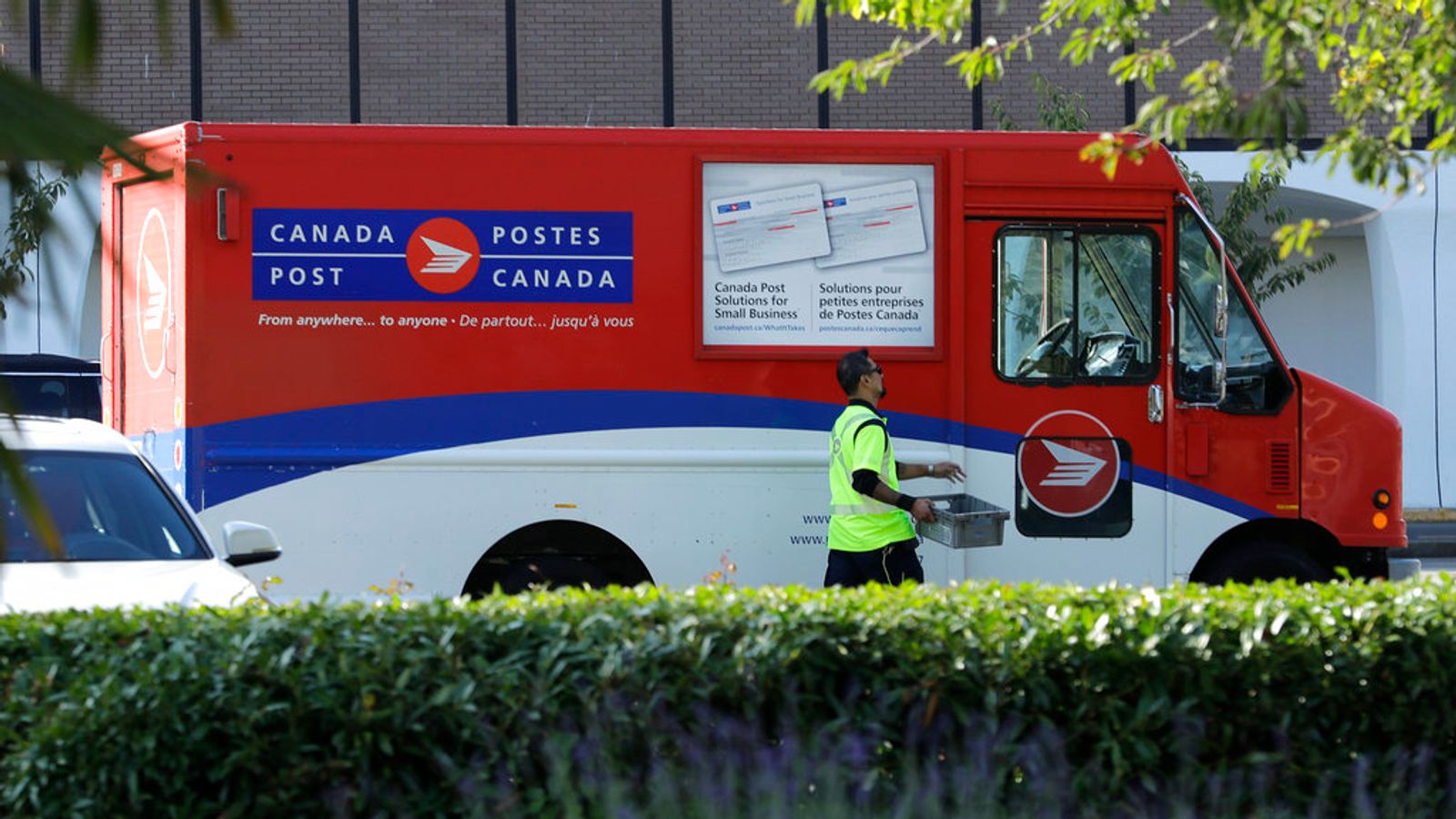
CUPW paves way for destruction of tens of thousands of jobs by reaching tentative agreements with Canada Post
[ad_1]
We encourage all postal workers to contact the Postal Workers Rank-and-File Committee at canadapostworkersrfc@gmail.com or by filling out the form at the end of this article.
Less than three days ahead of the holiday break, as postal workers laboured under the added burden of the Christmas rush, the Canadian Union of Postal Workers (CUPW) bureaucracy suddenly sprang a surprise of new tentative agreements on its 55,000 members in a short press release. The agreements for urban postal operations (UPO) and rural and suburban mail carriers (RSMC) are designed to facilitate the destruction of tens of thousands of full-time jobs in the coming years. This is the goal being pursued by Canada Post CEO Doug Ettinger and the Mark Carney-led Liberal government, which wants to set a precedent with Canada Post for a massive assault on all public services.
Throughout more than two years of bargaining, CUPW has worked consistently to smother opposition among rank-and-file postal workers to the ruling class’s drive to return the Crown corporation to profitability. This has included CUPW’s national leadership acting arbitrarily to enforce a government strike ban and sabotaging a national strike earlier this year by unilaterally imposing bogus “rotating” job action confined to isolated local stunts. When the union bureaucracy was compelled to sanction strike action on two separate occasions by the militancy of postal workers, the union leadership ensured that the strikers remained isolated from all other sections of workers and sabotaged any struggle directed against the Liberal government, which has used its powers to support management’s assault on workers at every turn.
These actions were all the more criminal given that the issues involved in the contract struggle—the use of new technologies like AI to accelerate exploitation, job security, decent wage increases and the defence of workers’ right to strike—are common to all workers and could have served as a starting-point for a broader mobilization of the working class as a whole against capitalist austerity and the restructuring of public services to meet the demands of the financial oligarchy.
Ettinger has made clear that restructuring plans for the post office include the elimination of up to 30,000 jobs over the next decade. New job classifications such as “Permanent Flex Employees,” “Part-Time Unstructured” employees and “Parcel Delivery Part-Time” employees are making their way into contract language. Workers may ask: how can Canada Post eliminate tens of thousands of workers, while at the same time creating three new job classifications?
First of all, these new job classifications will all but eliminate overtime opportunities that postal workers rely on for additional income. Second, these positions will be a far cry from permanent, full-time jobs, and they will be similar to the precarious gig economy that is taking over the parcel delivery and logistics industry at large. Third, the union is not concerned so much with the quality or viability of these jobs, so much as they care about improving their bottom line with more members forced to pay dues to an organization that has long ago abandoned them.
RSMCs will take longer to reach top rate, with a new 7-step wage progression, up from 5-steps. A bigger change for RSMCs is the hourly rate of pay system. One massive concession flowing from this is “fixed schedules with start and end times,” with daily schedules up to 9 hours. Currently, RSMCs have a “mail will be available at” time outlined in their route’s Schedule A document. They often have the discretion of exactly when to start their workday, and their shift concludes after their route is delivered. Implementing an end time punishes the fastest, most competent workers. What happens if a postal worker completes their scheduled 9-hour day in 7 hours? Additional work could be assigned, without any extra compensation, thereby taking work from another employee. The biggest problem with the hourly rate is being good at your job.
If an RSMC finds themselves on the other side of the equation, the daily calculation for overtime sounds like an improvement. But in the context of the proposed “flexible” and part-time job classifications, overtime will become scarce at best. As the UPO unit knows well, actually claiming overtime often triggers an investigation, management harassment and disciplinary measures.
CUPW is touting apparent “gains” for the UPO bargaining unit, including limitations on Separate Sort and Delivery (SSD), and the halting of dynamic routing and load-levelling. What is left unsaid is the corresponding elimination of door-to-door delivery and daily mail delivery. The supposed gains are rendered totally irrelevant in the context of these massive attacks on the public post office. What’s more, given that the final version of the contracts is not yet known, postal workers should wait for the small print. It may be that dynamic routing has simply been restricted to a few pilot projects or will be smuggled in through another loophole contained in the agreement’s legal jargon.
The agreements last 60 and 61 months respectively, extending the period during which postal workers are barred from any collective resistance against management’s government-backed onslaught on their jobs until January 31, 2029. As for wages, CUPW accepted an “increase” tied to the consumer price index for 2026 to 2028, a rate that always falls below price rises for basic necessities like groceries, fuel and rent. In addition, CUPW agreed to suspend cost-of-living-allowance increases for the duration of the agreement on the basis that wages between 2026 and 2028 are “protected from inflation” by the linking of increases to the CPI. The backdated “increases” for 2024 and 2025 of 6.5 percent and 3 percent respectively will are inadequate to offset the sharp price increases driven by pandemic-related inflation.
The tentative contracts, if approved, will pave the way for management to carry through the government-backed “Amazonification” of Canada Post. Carney’s Liberal government has had a major hand in this process. In advance of his government’s first budget, which plans to slash 40,000 jobs from the public service and massively boost military spending so Canadian imperialism can wage aggressive wars of plunder around the world, Carney declared that Canada Post is “unviable” in its current form. The government intervened repeatedly into the bargaining process to dictate negotiations, including by appointing a pro-management mediator and banning the postal workers’ first strike in December 2024.
CUPW and the rest of the union bureaucracy, including the Canadian Labour Congress (CLC), worked consistently to prevent workers from recognizing that the fight they face is a political one involving not just Canada Post management, but above all the Liberal government. As Canada Post worker Daniel Berkley put it in remarks to the World Socialist Web Site,
The government’s fingerprints are all over this rotten contract. WE must decisively vote down these sellout agreements. But it would be naive to think the Carney Liberal government wouldn’t countermand a “no” vote by us with binding arbitration or similar legislation, enforced of course by the CUPW. The union will not prepare us for a real fight, because they share the same conceptual framework as the government—corporate profits must come first—the public services we offer and good jobs come in second to nil.
Postal workers require an understanding of why the union bureaucracy lines up on the side of the Liberal government, for it is only on this basis that a path forward in the fight for decent-paying, secure jobs and the defence of all public services is possible. The roots of the corporatist partnership that has developed over the past four decades between trade union bureaucrats, government ministers and corporate executives like those at Canada Post are to be found in the unions’ nationalist, pro-capitalist politics.
Capitalist globalization in the 1980s eliminated the material conditions that allowed the unions in a previous period to secure limited gains for workers within a national framework. From then on, they became tools of management to extract concessions from workers on behalf of management with the aim of guaranteeing “competitiveness” and the profits of the union bureaucracy’s “own” national ruling elites. This rule applies to all unions, whether the once militant and nominally “left” CUPW, or more openly company unions like Unifor or the UAW in the US.
These are the basic issues at the heart of the postal workers’ struggle. Those forces, like the union bureaucracy, rooted in nationalism and a pro-capitalist outlook must accept the profit motive, which dictates ever worsening conditions for postal workers to cover shareholder payouts. Moreover, they divide workers along national lines under conditions in which the onslaught being waged by the capitalists on the working class is global in scope.
This international dimension is especially evident in the postal and delivery sectors. Moves to privatize the US Postal Service and Britain’s Royal Mail are at an advanced stage, while giant firms like Amazon, UPS and DHL coordinate their operations and attacks on workers worldwide.
Postal workers should respond with an entirely new program of struggle based on a perspective to unite all workers across Canada and internationally in defence of public services and good jobs for all. This demands new forms of organization: rank-and-file committees in every depot and sorting facility to mount an industrial and political counteroffensive by the working class against capitalist austerity, war and the gigification of work. At Canada Post, this course is being pursued by the Postal Workers Rank-and-File Committee (PWRFC), which is affiliated with the International Workers Alliance of Rank-and-File Committees. Berkley, a leading PWRFC member, explained,
The massive deterioration in working conditions across our entire industry, and even the economy at large, means that our struggle is shared among broader layers of workers. These are our allies that we must rally behind us! Not government ministers and corporate media personalities!
Simply put, it is impossible to reconcile the interests and needs of postal workers and the post office as a public service with the restructuring and profit mandates of the government. A supposed victory, taking load levelling and dynamic routing off the immediate agenda, is no victory at all in the context of the push to reduce mail delivery to twice per week and mass conversions to Community Mail Boxes (CMBs). Every day will be a heavy day under this new contract and overtime opportunities will become a distant memory.
I urge every postal worker reading this to get involved with organizing resistance to the tentative agreements by contacting us at the PWRFC today.
[ad_2]
Source link