I Sent a Letter to My Boyfriend Who Died Two Years Ago… “I Got a Reply? How Is That Possible?” [Maeil Business Behind Cinema]
[ad_1]
[Maeil Business Behind Cinema-2] The film ‘Love Letter’
‘Maeil Business Behind Cinema’ is a column that explores economic stories found in films. Its name is borrowed from the long-standing French film magazine ‘Cahiers du Cinéma.’ Here, we discuss economic news in a lighthearted way, as if chatting in the movie theater behind Maeil Business Newspaper. *Note: This article contains movie spoilers.
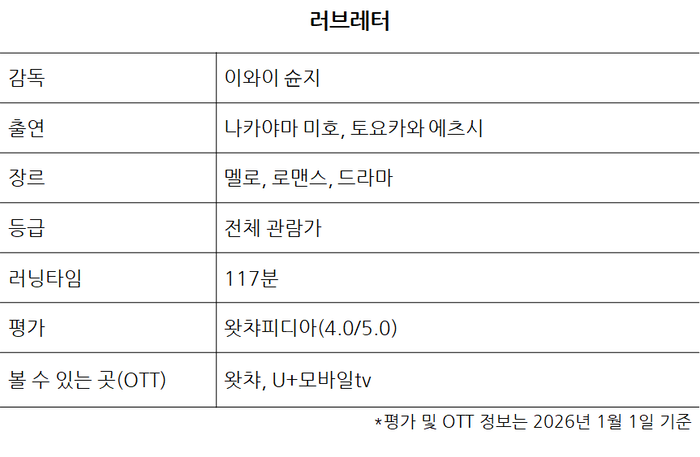
Directed by Shunji Iwai, ‘Love Letter’ (1995) tells the story of a woman who sends a letter to her boyfriend who passed away two years ago and unexpectedly receives a reply. It turns out the response came from another woman with the same name as her late boyfriend, who had actually been in the same class as him for three years in middle school. As the two women exchange letters, they come to understand the true feelings of the deceased, which they had not known before, and feel regret that there is now no way to return those feelings to him.
![The protagonist attends a memorial service marking the second anniversary of her boyfriend’s passing, finds his old address in his graduation album, and sends a letter. The story begins when she receives a reply. [Waterhole Company]](https://wimg.mk.co.kr/news/cms/202601/01/news-p.v1.20260101.64f51fdeb25d4bbd9b897c0a1462843e_P1.png)
In the film, letters serve as the key device that moves the story forward. Thanks to postal workers who deliver letters anywhere in the country, the two women are able to share memories of the departed. But what if the post office disappeared? In a world without demand for letter delivery services, mailboxes and postal workers would vanish, and a story like this would be hard to imagine. In today’s ‘Maeil Business Behind Cinema,’ we discuss how the status of Korea Post has changed as email has replaced handwritten letters.
![Mailbox [Yonhap News Agency]](https://wimg.mk.co.kr/news/cms/202601/01/news-p.v1.20260101.cbb6c69a38964b2c8227574707a27108_P1.png)
Denmark Ends 400 Years of Postal Service
In reality, PostNord, the company providing postal services in Denmark and Sweden, discontinued letter delivery in Denmark at the end of last year. Denmark had offered letter delivery through post offices for more than 400 years, since 1624, but this suddenly came to a halt. The reason was a sharp drop in demand for letter services. Over the past 25 years, letter mail in Denmark has declined by more than 90%. Denmark is considered one of the world’s fastest digitalizing countries, and as all public documents are now processed digitally, it has become difficult to maintain letter delivery. As a result, 1,500 people providing related services will be laid off and 1,500 red mailboxes will be removed across Denmark. In the future, private courier company dao will take over postal operations.
![A vehicle of the Danish state-owned postal company PostNord driving on a road in Denmark. PostNord has decided to end its postal services. [AP Yonhap News Agency]](https://wimg.mk.co.kr/news/cms/202601/01/news-p.v1.20260101.d1cf5f5837a04a3b8c8b4090d0996107_P1.png)
The decline of letter services is not unique to Denmark. In Korea, the total number of post offices dropped from 3,658 in 2008 to 3,335 in 2024, a decrease of more than 300. The number of mailboxes, which reached 58,000 nationwide in 1993, fell to fewer than 8,000 as of last year. This is because people no longer send enough letters to justify maintaining the previous scale of mailboxes. Postal business deficits are also growing, making it difficult to secure funds to maintain delivery services. According to Korea Post, the postal deficit in 2023 was 157 billion won, up 10 billion won from 2019. This is attributed to declining mail volume and postal rates that have been frozen for four years. Consequently, Korea Post has recently called for an increase in postal rates to ensure the sustainability of its postal business.
![Mailboxes across Denmark will be removed following the end of letter delivery. [European Pressphoto Agency (EPA) Yonhap News Agency]](https://wimg.mk.co.kr/news/cms/202601/01/news-p.v1.20260101.4acbee46e6bb4a5898b1a3469775f9d3_P1.png)
Transformation of Korea Post… Becoming a Financial Hub Filling the Void Left by Banks
Will Korea’s state-run post office follow Denmark and discontinue postal services? For now, that seems unlikely. However, Korea Post is seeking alternative businesses that can leverage its nationwide infrastructure. One notable shift is the strengthening of its role as a financial institution. According to Korea Post, as of the end of 2024, Korea Post deposits surpassed 100 trillion won for the first time in history, increasing by more than 4 trillion won in a single year. In addition, Korea Post’s insurance business is approaching 65 trillion won, bringing the combined total of deposits and insurance to about 170 trillion won.
![The film 'Love Letter' prompts viewers to reflect on the meaning of writing a letter. [Waterhole Company]](https://wimg.mk.co.kr/news/cms/202601/01/news-p.v1.20260101.5d8533d856324cf98c4b6f6d97ff7bc6_P1.png)
Korea Post is preferred as a place to deposit money because it offers full deposit protection. Last year, private financial institutions, including banks, raised the deposit protection limit from 50 million to 100 million won through the Korea Deposit Insurance Corporation (KDIC). In contrast, Korea Post provides unlimited government-backed protection for deposits. As long as the country stands, Korea Post deposits are considered completely safe. Currently, the highest interest rate for deposits sold at Korea Post is around 2.9% per year. This is higher than the average rate at commercial banks, though slightly lower than the highest-yielding products. Wealthy savers may consider mixing bank and Korea Post deposits as a savings strategy. One could lock in the maximum amount at the highest-rate products in the banking sector, and place the remaining cash at Korea Post.
![Even those who haven’t seen 'Love Letter' are likely familiar with the protagonist’s iconic “Ogenkidesuka” scene. The film was beloved by many Korean audiences. [Waterhole Company]](https://wimg.mk.co.kr/news/cms/202601/01/news-p.v1.20260101.6bb79064857a4274915264c28c9f3732_P1.png)
Starting this year, Korea Post’s role as a financial institution will expand further. The Financial Services Commission (FSC) has allowed Korea Post to offer banking services, including loans, from this year. In the first half of the year, about 20 main post offices nationwide will begin selling loan products from the four major banks, and more Korea Post branches will be able to handle banking services in the future. This policy is designed to help seniors and others unfamiliar with digital financial services. As bank branches close in depopulated areas, financial functions are being distributed to Korea Post.
![Korea Post providing financial services [Korea Post]](https://wimg.mk.co.kr/news/cms/202601/01/news-p.v1.20260101.2b93c47b933f47d3b49cf4031f0b5393_P1.png)
Mailboxes Weren’t Always Red
In ‘Love Letter,’ the red mailbox adds to the film’s romantic atmosphere. The contrast between the white snow and the red mailbox evokes the image of a wax seal stamped on a white envelope. Historically, however, mailboxes were not always red. When mailboxes were first installed in the UK in 1852, they were painted dark green to blend in with the surroundings. However, complaints arose that green mailboxes were hard to spot, so in 1874 the Royal Mail adopted red as the standard color for maximum visibility. This standard spread to Commonwealth countries and Japan, and was introduced to Korea during the Japanese colonial period. Meanwhile, the United States and Russia use blue mailboxes, while Germany and France use yellow, reflecting national differences.
![Mailboxes Through the Ages [Korea Post]](https://wimg.mk.co.kr/news/cms/202601/01/news-p.v1.20260101.3b1216a9b1d649ee8f994983a8c9d941_P1.png)
Just as Korea Post is finding new roles, mailboxes are also being repurposed for broader uses, such as environmental protection. Korea Post recently signed an agreement with the Ministry of Climate, Energy and Environment, K-Green Foundation, and Philip Morris Korea Inc. to collect used electronic cigarette devices by mail. Consumers can seal used devices in a special mail-back envelope and drop them in a mailbox, after which Korea Post delivers them to recycling companies. Previously, used electronic cigarettes were often illegally discarded, causing environmental harm, but this initiative is expected to help resolve such issues.
![Collecting Coffee Capsules Using Mailboxes [Korea Post]](https://wimg.mk.co.kr/news/cms/202601/01/news-p.v1.20260101.88e9db90b1534f4f80256ff475b2f9d7_P1.png)
A mail-back service for unused medicines is also underway. If you mark and seal unused medicines and drop them in a mailbox, a postal worker will collect them. Korea Post is also collecting used coffee capsules in this way. As waste increases exponentially in modern society, the role of mailboxes in environmental protection is expected to grow.
![As the story moves between past and present, the protagonist discovers new sides of her lover. [Waterhole Company]](https://wimg.mk.co.kr/news/cms/202601/01/news-p.v1.20260101.f47535ccaf4e4cceb27f0eef33113f06_P1.png)
The Enduring Appeal of ‘Slow Communication’ in the Age of Instant Messaging
Recently, Korea Post has partnered with Starbucks to launch the ‘Slow Mailbox’ project. If you drop a postcard into a slow mailbox at a Starbucks store, it will be delivered for free to the address written on it one year later. Similar projects are underway at hundreds of locations nationwide, including Pak Kyongni Literature Park in Wonju and Imjingak Pyeonghwa Nuri Park in Paju. Even in an age where messages can be sent in seconds with a few taps, there is still demand for writing letters by hand and sending them slowly, with a time delay.
![Starbucks' Slow Mailbox [Starbucks Korea]](https://wimg.mk.co.kr/news/cms/202601/01/news-p.v1.20260101.6ea58a588f664dde8806acb9083f5287_P1.png)
Perhaps this demonstrates that some feelings are conveyed more sincerely when delivered over time. Just like the protagonists of ‘Love Letter,’ who slowly reached the hearts of those from the past through handwritten letters. One day, state-run postal services in Korea may end, and mailboxes may disappear into history, just as in Denmark. Even then, the desire to deliver heartfelt messages slowly and meaningfully to loved ones will likely persist, albeit in different forms.
![Poster for the film 'Love Letter' [Waterhole Company]](https://wimg.mk.co.kr/news/cms/202601/01/news-p.v1.20260101.3fc7d597842d419d876b6c422e9ff964_P2.png)

‘Maeil Business Behind Cinema’ is a column that explores economic stories in films available on OTT platforms. Click the subscribe button on the reporter’s page below to read more reviews.
This article has been translated by GripLabs Mingo AI.
[ad_2]
Source link