‘Alpha male’ AI world shuts out women: computing prof Hall
[ad_1]

Artificial intelligence could change the world but the dearth of women in the booming sector will undermine pledges for inclusive technology, top computer scientist Wendy Hall told AFP on Friday.
Hall, a professor at Britain’s University of Southampton known for her pioneering research into web systems, said that the gender imbalance had long been stark.
“All the CEOs are men,” the 73-year-old said, describing the situation at a major AI summit held in New Delhi this week as “amazingly awful”.
“It’s totally male-dominated, and they just don’t get the fact that this means that 50 percent of the population is effectively not included in the conversations.”
Gender bias “creeps through everything, because they don’t think about it when they build their products”, Hall said.
She was speaking in an interview at the AI Impact Summit, where dozens of governments are expected to lay out a shared vision on how to handle the promises and pitfalls of generative AI.
Prime Minister Narendra Modi, who is pushing for India to become a global AI power, said Thursday that advanced computing systems “must become a medium for inclusion and empowerment”.
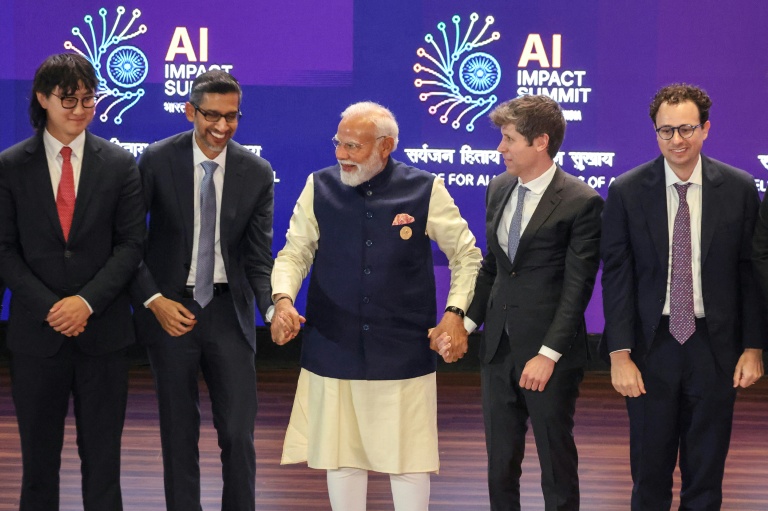
But when he posed on stage for a photo with leading tech business figures, 13 men were present and only one woman — Joelle Pineau, a former Meta researcher who is now chief AI officer at Cohere.
It was a similar story at another photo opportunity with world leaders including French President Emmanuel Macron and Brazil’s Luiz Inacio Lula da Silva.
– ‘Biased world’ –
Many studies have shown how generative AI tools like ChatGPT and Google’s Gemini reflect stereotypes contained in the vast reams of text and images they are trained on.
“We’re a biased world, so the training is done on biased data,” Hall said.
A 2024 UNESCO study found that large language models described women in domestic roles more often than men, who were more likely to be linked to words like “salary” and “career”.
While tech companies work to counter these built-in machine biases, women have found themselves targeted by AI tools in other ways.
Several countries moved to ban Elon Musk’s Grok AI tool this year after it sparked global outrage over its ability to create sexualised deepfakes depicting real people — mostly women — in skimpy clothing.
Hall, a longtime advocate for women in technology, said that things had “not really improved that much” since she had her start decades ago.
[ad_2]
Source link