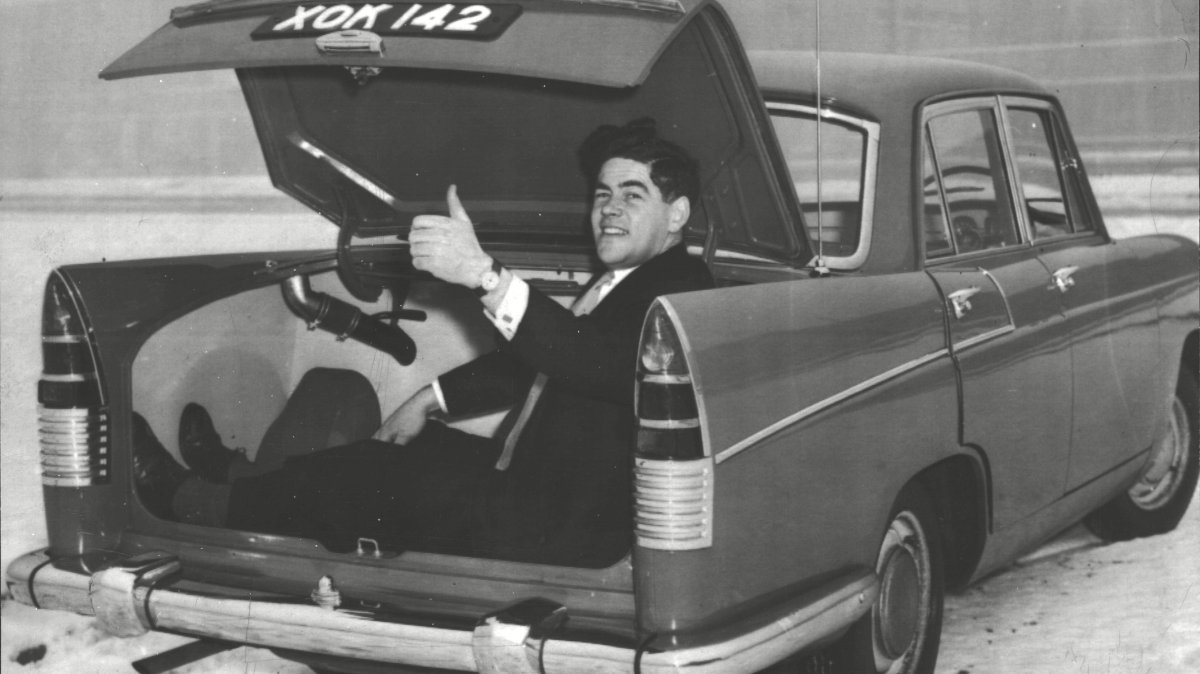
Keith McDowall obituary: non-spinning spin doctor
[ad_1]
When Keith McDowall titled his autobiography Before Spin he was making a point. During his years in Whitehall as a non-spinning media guru, he was scrupulously non-partisan and rigorously honest.
Serving Conservative and Labour ministers during the premierships of Harold Wilson, Edward Heath and James Callaghan, he instructed his staff never to lie to the media. “We were impartial,” he said. “One day I was working for Willie Whitelaw and the next, Michael Foot,” he said. “In terms of political ideology, you can’t get any more different than that.”
He was equally loyal to them both. Yet his primary loyalty was not to whoever happened to be in power but to ethical governance and the title of his book, published in 2016, was a deliberate tilt at the breed of modern spin doctors who came after him with an agenda dictated by party allegiance rather than traditional civil service neutrality. They were oblivious, he believed, to the actual role of a press officer, which he defined as a duty to uphold parliamentary standards, honour in public life and the integrity of the government. “We told the truth,” he said. “We could choose not to answer a question, but we never lied.”
He had spells at the Home Office, the Board of Trade and the environment and employment ministries and although his own political sympathies lent to the left, of the numerous cabinet ministers he served, his favourite was Whitelaw, later to serve as Margaret Thatcher’s de facto deputy prime minister.
Whitelaw was not a natural media performer when he took over the newly established Northern Ireland Office in 1972 but McDowall, who joined him on day one, trained him to became an effective communicator. He was invaluable in other ways too for he already had experience in Ulster having worked for Callaghan when he was home secretary.
With sectarian violence escalating, in 1969 Callaghan took the decision to deploy British Army troops in the province and McDowall accompanied the home secretary to meetings with the leaders of both Protestant and Catholic communities.
He recalled the Rev Ian Paisley giving Callaghan a particularly hard time. “Come, come, Dr Paisley, we’re all children of God,” Callaghan told him. “We are not. We are all children of wrath — Ephesians ii, 3,” Paisley snapped back.
After Labour lost the 1970 general election, he continued to serve Reginald Maudling, the new Conservative home secretary. He found Maudling indolent and reluctant to visit Ulster. When McDowall finally persuaded him to do so, he was appalled when Maudling slumped into his seat on the flight home and exclaimed, “For God’s sake bring me a large scotch — what a bloody awful country!”
After Heath appointed Whitelaw as secretary of state for Northern Ireland, McDowall saved his boss’s political career when Whitelaw secretly met the IRA’s leaders in London. When the IRA leaked the story Whitelaw decided he would have to resign. McDowall talked him out of it and helped to draft a Commons statement in which Whitelaw explained the pressure for talks and how he had felt “unclean” while sitting down with terrorists. He stayed in office and McDowall went on to assist him in managing the consultations with Ulster’s political parties that led to the Sunningdale power-sharing agreement in 1973.
However, before the agreement was concluded, Heath moved Whitelaw to become secretary of state for employment. Thatcher once famously said “every prime minister needs a Willie” and Heath did too. Facing industrial action by the miners in defiance of the government’s statutory incomes policy, he needed Whitelaw to take on the National Union of Mineworkers and McDowall moved to the Department of Employment with him.
By then McDowall had developed a strong personal affection for the bluff former guardsman who had been awarded the MC in the Second World War, and whom he reported was a delight to work for: decisive, good-humoured and unswervingly supportive of his staff.
Whitelaw, however, was unable to sort out the miners’ dispute. With Britain on a three-day week, Heath called a snap election on a “who governs Britain?” ticket — and lost. McDowall remained in post as Michael Foot took over at employment and he became a close friend of the Labour man, although he felt Foot was a “pushover” in negotiations with the unions and should never have settled a 35 per cent pay increase on the striking miners.
McDowall’s impartiality was tested when in 1988 he married his second wife Brenda Dean, the general secretary of the print union Sogat, who was leading her members on the picket line at Wapping during the bitter dispute with Rupert Murdoch’s News International.
At the time McDowall was deputy director-general of the CBI and the personal link between the leadership of the bosses and the workers was a conflict of interest too far. McDowall, who was a lifelong member of the National Union of Journalists, resigned his post.
His wife became the Labour peer Baroness Dean of Thornton-le-Fylde and predeceased him in 2018. He is survived by his daughters Clare and Alison from his first marriage to Shirley Astbury, which was dissolved in 1985.
Keith Desmond McDowall was born in 1929 in Croydon, the son of Edna and William McDowall, the manager of an engineering works. During the Second World War he endured a difficult adolescence. His father died of cancer when he was 12 and his family’s house was hit by a German flying bomb. By the age of 15 he was an air-raid warden and on leaving Heath Clark Secondary School at the end of the war, he worked as an office boy at the Croydon Times and a library assistant at The Daily Telegraph.
After National Service with the RAF, he joined the South London Press as a reporter in 1949. Six years later he graduated to Fleet Street, joining the Daily Mail, where he became an industrial correspondent, which brought him into contact with national trade union leaders and Labour politicians.
A story he wrote in 1967 about a plastic brick intended to revolutionise the building industry so inspired him that he abandoned journalism to become the managing director of the company making the bricks. The venture was a disaster. When the brick failed a fire test he found himself out of a job and applied to join the Government Information Service.
After a decade in Whitehall, he was headhunted in 1978 as head of public affairs at British Shipbuilders. Two years later he took up a similar post at the CBI and subsequently set up Keith McDowall Associates (KMA), where clients included Royal Mail, the Co-Op and Kiss FM.
He remained close to the Labour movement, hosting its leaders at networking parties. The Labour leader John Smith spent his last evening in McDowall’s company and he used his contacts to bring together Tony Blair and business leaders.
After selling KMA in 1998, he enjoyed a vigorous retirement, keeping a yacht and a second home in Cornwall, following the England cricket team on overseas tours and organising jazz concerts at the Reform Club.
Keith McDowall, journalist and civil servant, was born on October 3, 1929. He died on November 22, 2025, aged 96
[ad_2]
Source link