Carney’s Anglo demarche: Teck deal is a triumph of short-termism, says ALEX BRUMMER
[ad_1]
Britain has a terrible record when it comes to selling its crown jewels.
An obsession of being open for business has seen prized assets such as Thames Water, Heathrow, tech champion Arm Holdings and defence trailblazers Ultra Electronics and Cobham fall into overseas hands.
The National Security and Investment Act, designed to prevent plundering, might as well not exist, with the sale of Welsh chip-making minnow Newport Wafer Fab, one of the few deals to have been blocked.
Inattention in Whitehall and the extraordinary turnover in business secretaries doesn’t help.
Peter Kyle is the latest arrival having taken over from Jonathan Reynolds – the man who sold Royal Mail – after a tenure of just over a year.
The US always has been tougher on overseas interlopers. It took several years and robust undertakings for Nippon Steel to acquire US Steel.

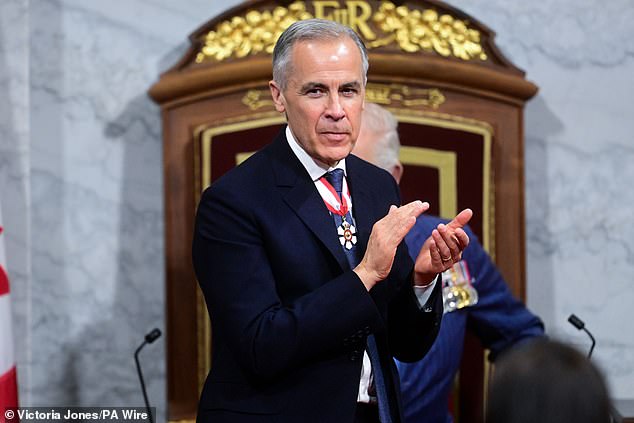
Hardball: Canadian Prime Minister Mark Carney told Anglo American to move its headquarters from London to Canada to win backing for a £40bn merger
A pledge that the headquarters of the enlarged group would be in Pittsburgh, home to the American steel industry, was mandated.
Canadian prime minister Mark Carney reportedly played hardball with Anglo American in its ‘merger of equals’ with Vancouver based copper firm Teck Resources.
Even though Anglo will have 62.4 per cent of the equity in the transaction, Anglo’s chief executive Duncan Wanblad had to concede headquarters would be in Vancouver to get it over the line.
That is a long way from the centres of gravity in Britain and South Africa for a mining giant with a heritage dating back to 1917.
It is not the first time that Canadian politicians and regulators have taken a firm stance with the City.
In 2011, the London Stock Exchange was blocked from a £2.7billion takeover of its Toronto counterpart.
The deal would have created a natural resources behemoth which potentially would have attracted initial public offerings from across the globe.
It might have stopped BHP shifting its listing to Sydney. Carney should take credit for standing up for the Maple Leaf.
The concern must be that a company with a Canadian chairman and headquarters will eventually decide to move its share listing across the Atlantic.
Anglo American investors doubtless are very excited at the promised arrival of a £3.3billion special dividend, after fallow times.
But the Teck deal is a triumph of short-termism with Anglo making too many concessions.
Private grief
The timing of Britain’s latest labour market figures inevitably means that the focus is on the impact of the Bank of England interest rate setters.
Ideally, with the jobs market softening and wage growth, excluding bonuses, dropping to 4.8 per cent, the Bank would give growth a lift by cutting rates. Above target inflation precludes that.
The markets are hoping for a slowdown in the Bank’s programme of selling its government stock holdings to the market –quantitative tightening.
A change might relieve pressure in the gilts market where longer-term yields are at disturbing levels raising the cost of financing the national debt.
Most worrying is the steady decline in private sector payrolls by 153,000 since the last Budget.
There is no comfort to be drawn from the fact that the public sector is getting fatter, with 75,000 new employees under Labour.
Aside from the strain on the Government’s spending, the expansion of the state increases unfunded pension liabilities.
There is no reason to think that the jobs market is going to get any better for Labour’s ‘working people’. The high costs of the Employment Rights Bill, increases in the minimum wage and AI spell the loss of more payroll jobs.
Road rage
When a cyber-attack punished the nation’s favourite retailer Marks & Spencer earlier this year, it captured the headlines when empty shelves temporarily appeared.
An attack on the UK’s prestige car maker Jaguar Land Rover (JLR) has been even more debilitating.
Production has ground to a halt and the group’s 33,000 staff have been told to stay at home for another week. The stoppage is affecting a further 104,000 workers across the country in a complex supply chain.
Trades union Unite’s response typically is to demand support from government.
Nice try, but owners Tata should take the hit.
DIY INVESTING PLATFORMS

AJ Bell
AJ Bell
Easy investing and ready-made portfolios
Hargreaves Lansdown
Hargreaves Lansdown
Free fund dealing and investment ideas

interactive investor
interactive investor
Flat-fee investing from £4.99 per month

InvestEngine
InvestEngine
Account and trading fee-free ETF investing

Trading 212
Trading 212
Free share dealing and no account fee
Affiliate links: If you take out a product This is Money may earn a commission. These deals are chosen by our editorial team, as we think they are worth highlighting. This does not affect our editorial independence.
Compare the best investing account for you
[ad_2]
Source link


