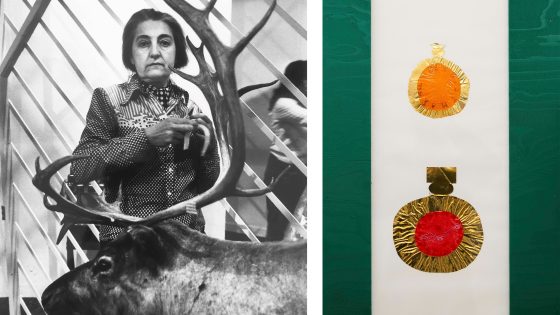
Come Deck the Halls! – Alison Smithson’s Christmas cards
[ad_1]
When I worked on The Architectural Review, come Christmas season, a stream of architects’ greetings cards would trickle fitfully into the office. Many were self-designed, usually featuring trees, puddings or Santa’s sleighs, knowingly reworked as architectural drawings. It was amusing at first, but the yuletide in-jokes grew decidedly laboured. Once you’ve seen one annotated section through a Christmas pudding, you’ve seen them all.
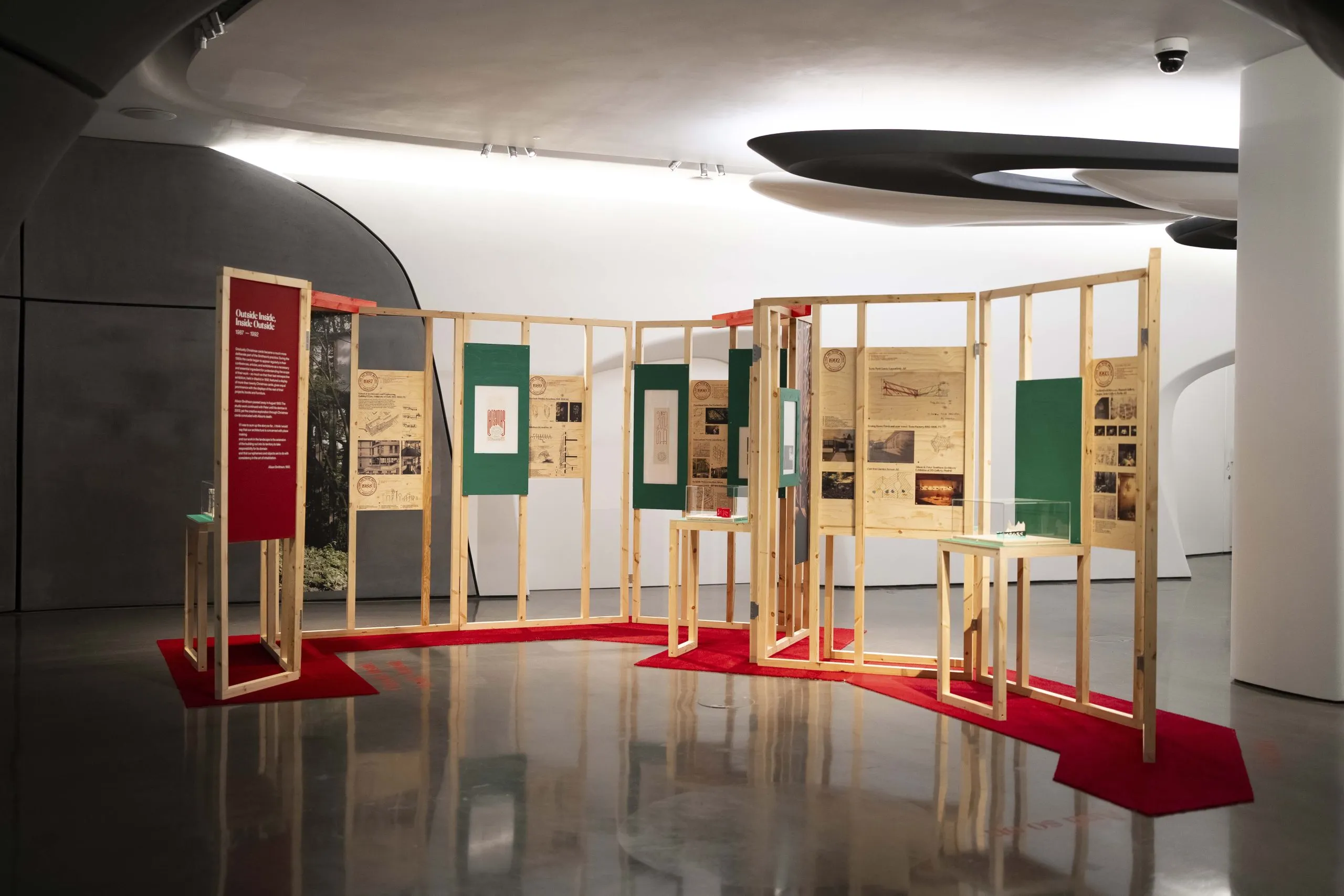
Installation shot: Come Deck the Halls! Alison Smithson: Intertwining Life and Art at Roca London Gallery. Source: Photographer London
The most seriously effortful and elaborate ‘cards’ came, perhaps not surprisingly, from the office of Thomas Heatherwick. One year there was a ‘pine cone’ fabricated from 1p stamps, glued together to make up the required postage rate. Another year it was a floppy dollop of clear plastic, which turned out to be a mould of part of a traditional red post box. You have to hand it to the Royal Mail for not flinching and (literally) delivering the goods.
The tradition of sending Christmas cards dates from the mid-19th century, but now digital greetings are edging out analogue artefacts. So it’s momentarily heartening to be reminded of those yuletide spurts of creativity through Come Deck the Halls!, featuring the Christmas ephemera of Alison and Peter Smithson, on view at the Roca London Gallery until the end of January.
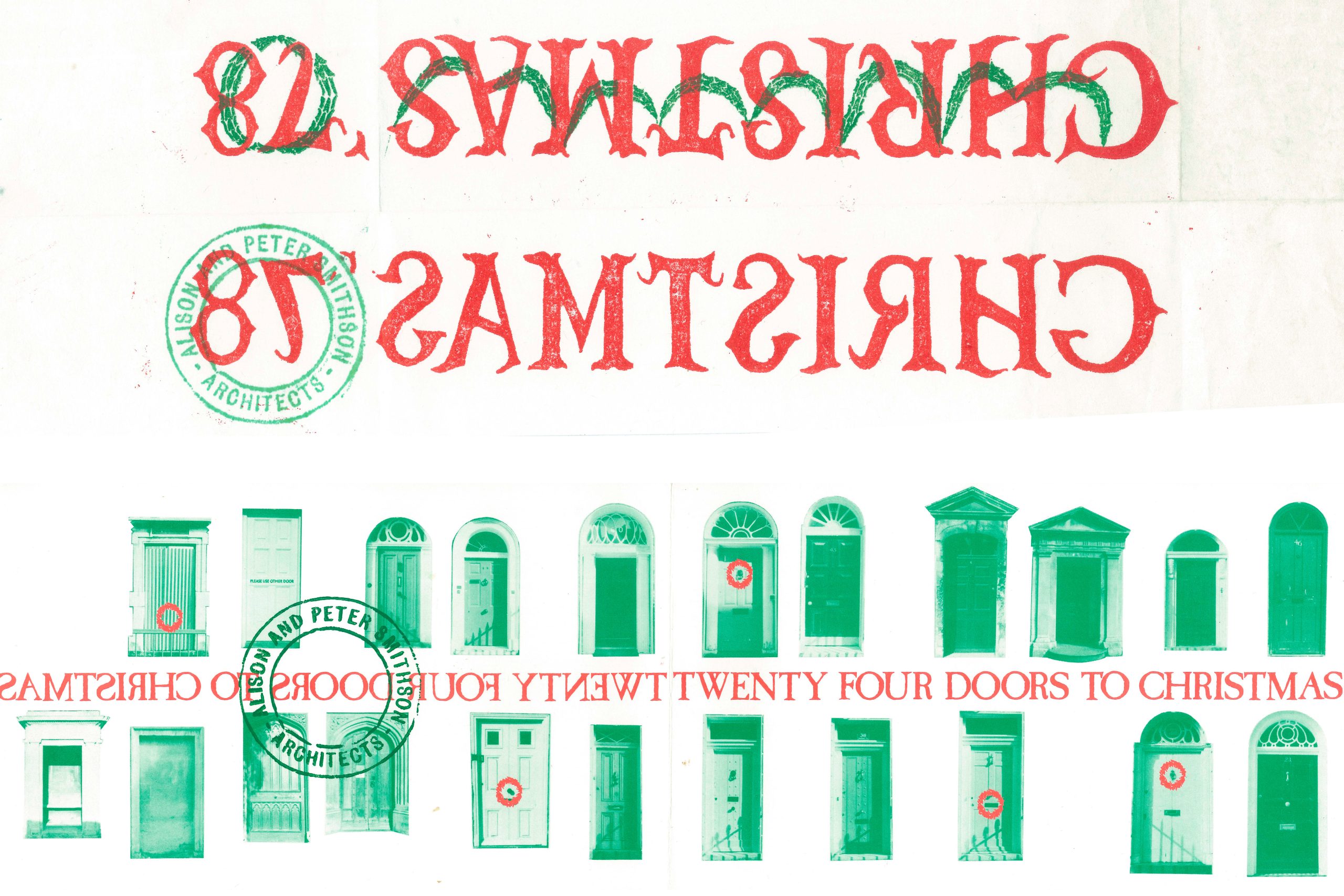
Top: Alison Smithson; 1978 Christmas card and Kettles Yard catalogue. © Smithson Family Collection; Alison Smithson; 1979 Christmas card and Kettles Yard catalogue. © Smithson Family Collection
On the face of it, the Smithsons and the saccharine sentiment of Christmas cards might seem like strange bedfellows. Yet, throughout their career, they pursued a rich sideline in the design of cards, bunting, invitations, banners, books and wrapping paper. Alison Smithson took the lead in this process of creation and the exhibition explicitly foregrounds her contribution, from 1956 to 1992, while setting it in the context of the Smithsons’ wider oeuvre. Their preoccupation with how use and occupation – ‘the art of inhabitation’ – gave meaning to architecture has a particular resonance at Christmas, when people decorate and transform their environments.
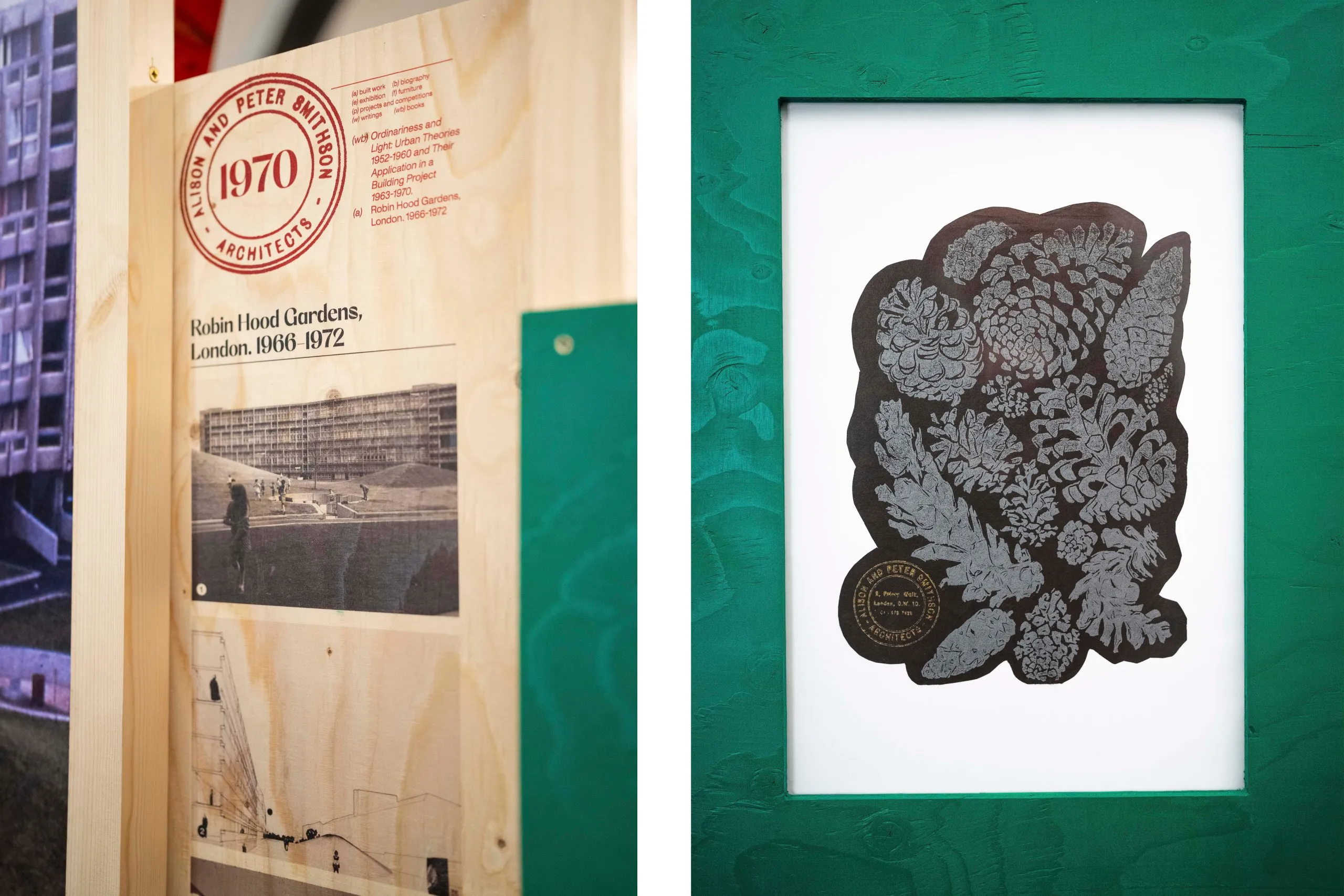
Left and right: installation shots: Come Deck the Halls! exhibition at Roca London Gallery. Source: Photographer London
Curated by architect Ana Ábalos-Ramos, it’s an intimate representation of the ephemeral and the permanent, professional and personal, lives and art, inextricably conjoined and intertwined. The Smithsons’ was a life of ‘conglomerate ordering’, a phrase coined by Alison Smithson in 1984, ‘of the rarest and yet the most ordinary kind’. One in which, as in a plum pudding, ‘some ingredients are still recognisable, but most are an inextricable part of a general mass’.
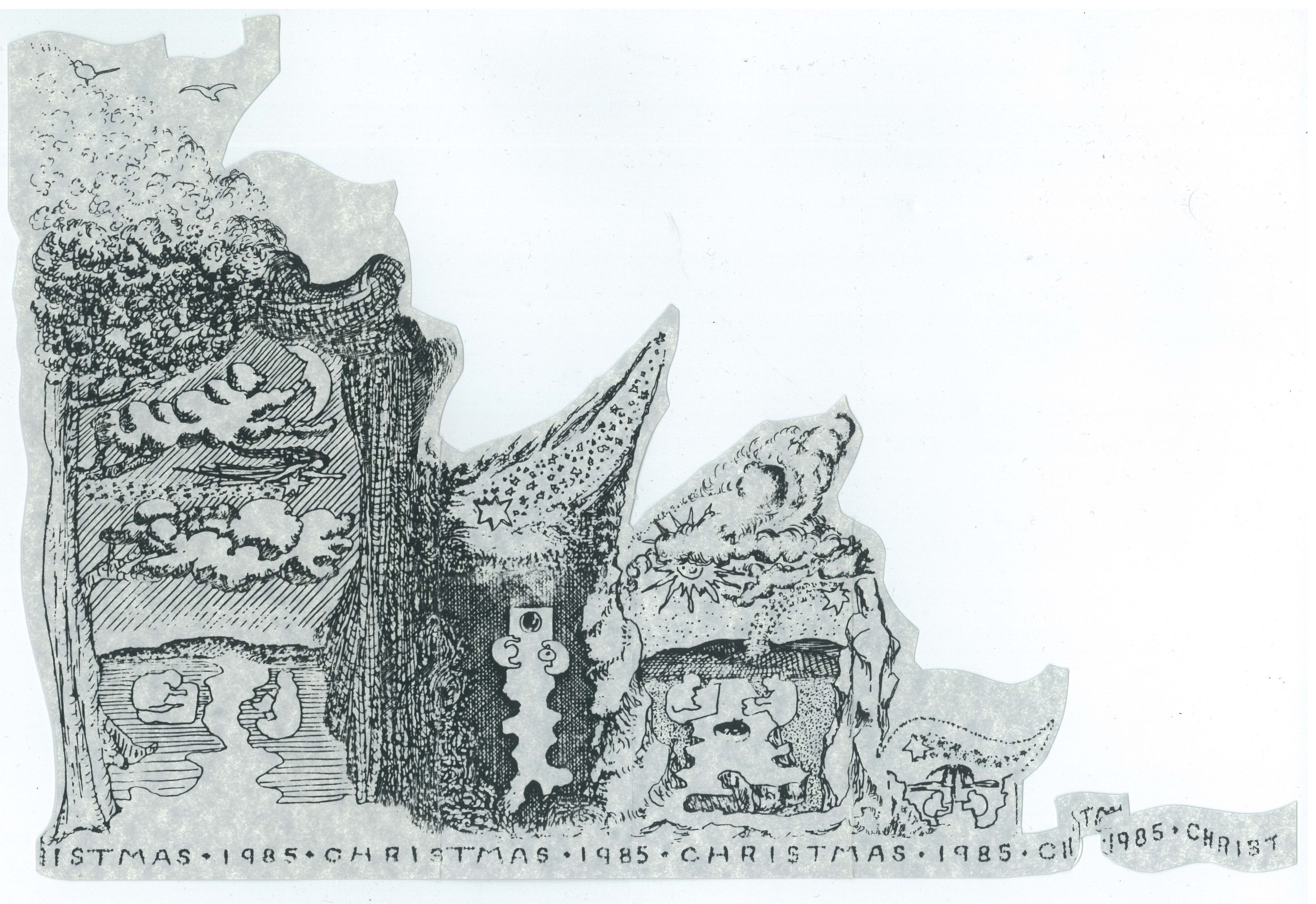
Alison Smithson: 1985 card interior. © Smithson Family Collection
Although the Smithsons began making and sending their own Christmas cards in 1949, it was not until 1956 that they became ‘mood carriers’, as vehicles for their ideas and work. From then on, certain themes become evident: the presence of nature, diverse graphics and printing processes, and the importance of materials. Coloured tissue paper would be collaged, textured and overlaid to create different effects, silver card embellished with designs from hand-made printing blocks. There are even some pine cones (real as opposed to confected), gussied up in red felt robes and cotton wool beards, along with a couple of infant Jesuses swaddled in paper doilies.
From the start of their career, the Smithsons developed an expansive spectrum of graphic language, fertilised by their connection with artistic circles in London at that time, particularly other members of the Independent Group. The ‘as found’ aesthetic became a recurring theme; how a ‘new seeing of the ordinary’ and an openness as to how prosaic ‘things’ could re-energise inventive activity.
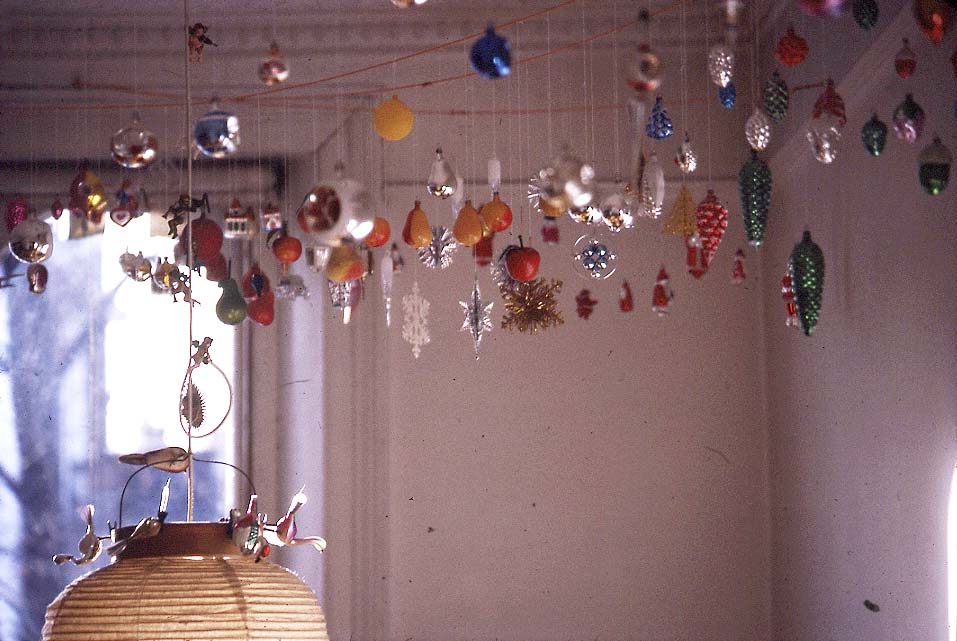
Christmas decorations at Cato Lodge. © Smithson Family Collection
The exquisitely tactile quality of the cards forged a personal, tangible link between the Smithsons and those receiving them. Finnish architect Juhani Pallasmaa describes the nuances conveyed by hand-made items, likening the experience to looking more intently at a painting: ‘The surface of cracked paint conveys a sense of materiality, work and time, and I find myself thinking of the inspired hand of the painter holding a brush.’
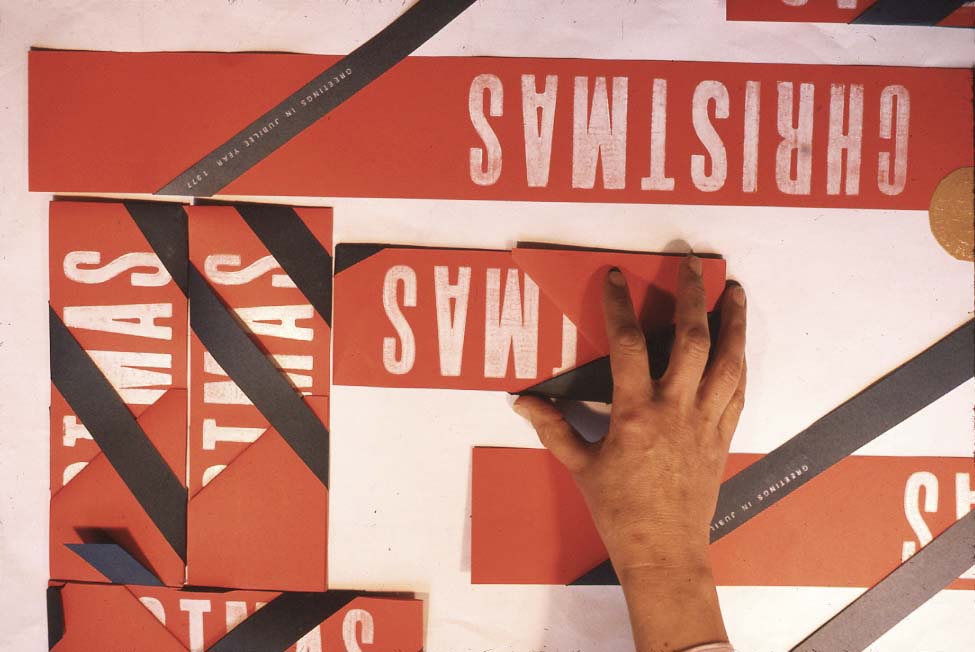
Alison Smithson: 1977 wooden typeset Christmas card. © Smithson Family Collection
Mounted on display screens fabricated from timber and plywood, the Christmas ephemera is divided into chronological eras and partnered with the Smithsons’ building projects of time, emphasising the reciprocity between life and work. Peter Smithson saw ephemera as ‘small, fleeting architectures’ in which ‘ideas are tried out; performing the same role in the small as exhibitions at real scale … in transient material in advance of permanent construction’.
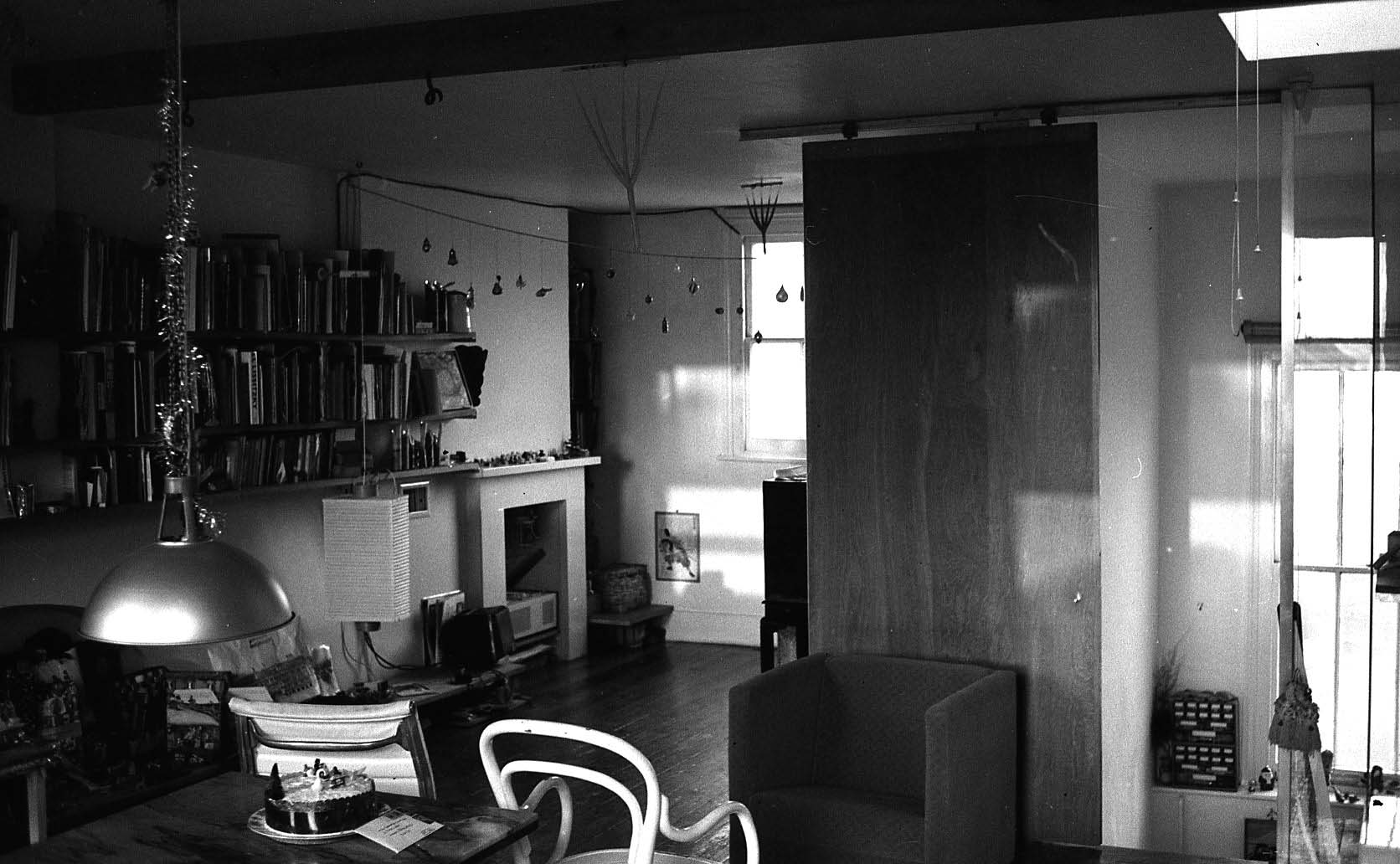
Priory Walk Xmas decorations. © Smithson Family Collection
Zig-zagging subversively through the pristine contours of Roca’s Zaha Hadid-designed gallery, the timber screens recall the timber trellises of the Smithsons’ student housing at St Hilda’s College and their fairytale Hexenhaus, set in a German forest. The exhibition’s evidently hand-made and hand-built nature conjures an otherworldly juxtaposition with Hadid’s self-consciously ‘futuristic’ interior, conceived as a hectic concatenation of mechanistic whorls and swirls. Red and green, the colours of Christmas, but also of Saturnalia, zing out from this glacially sterile backdrop, like a holly tree in the snow.
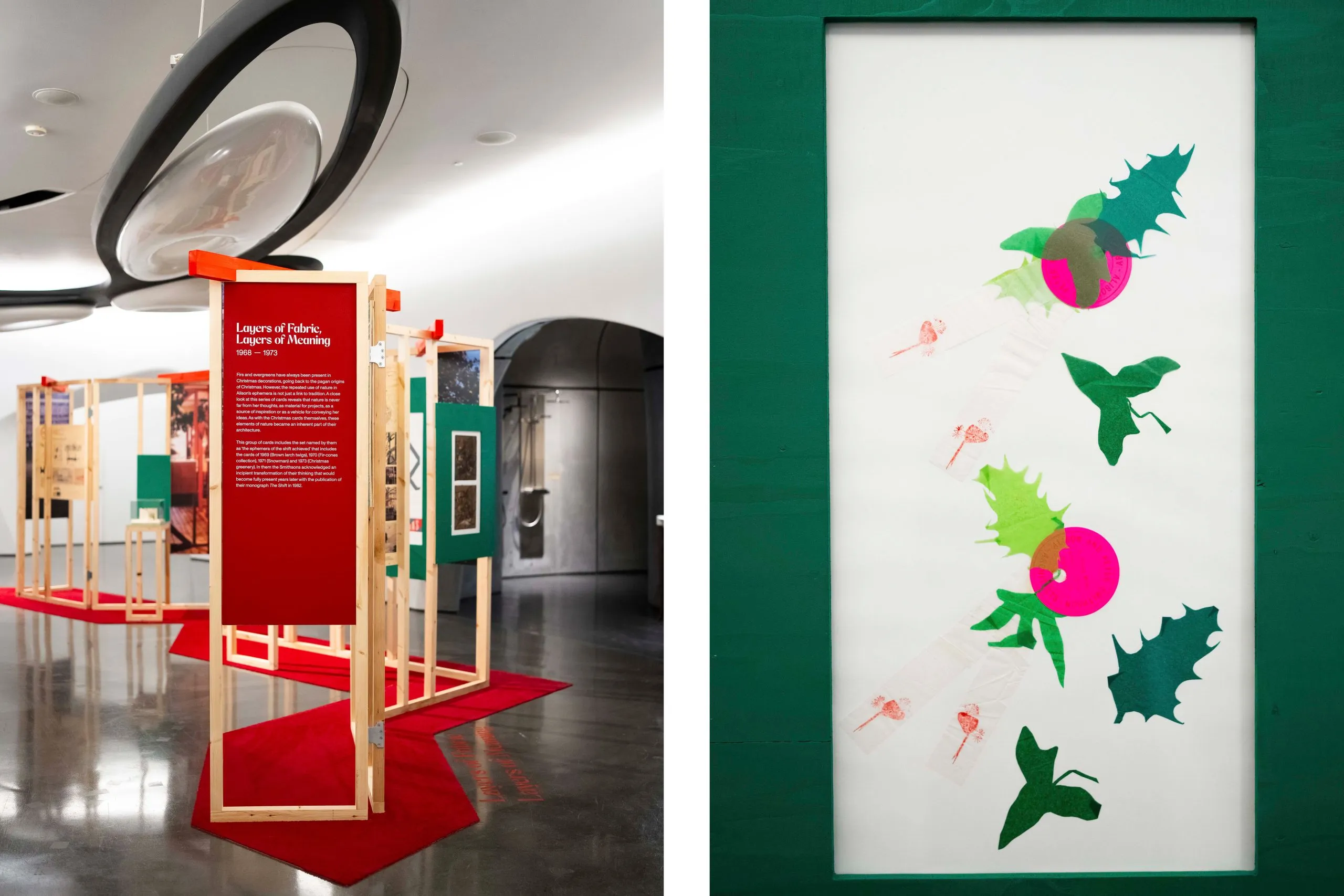
Left and right: installation shots: Come Deck the Halls! exhibition at Roca London Gallery. Source: Photographer London
A short film of slides from the Smithsons’ archive amplifies the mood: streets decked in Christmas lights, clusters of baubles, ornaments dripping from a ceiling like gleaming stalactites, ‘a staging carried by the transformation of the familiar’, as the Smithsons described it.
Beyond the engulfing blare of consumerism, Christmas can still be seen as a time of renewal, its deeply ancient, per-Christian roots celebrating the return of light in the darkest depths of the year. Alison Smithson saw the design of cards as a chance to immerse herself in the spirit of Christmas, look forward to the future, reflect on the past, and maintain the sense of expectancy that Christmas still invokes, on the cusp of a new year.
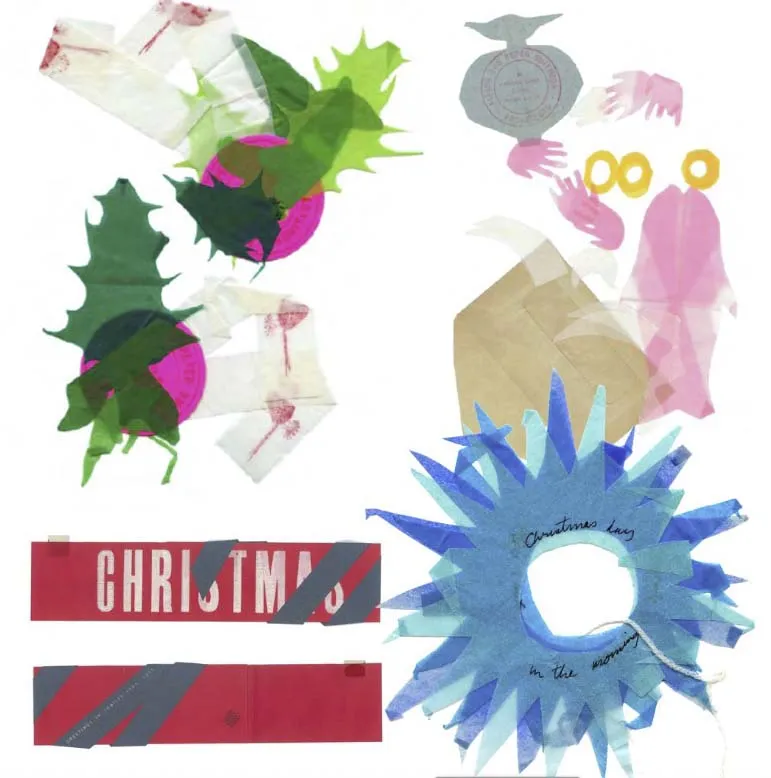
Compilation 4 cards at different scales. © Smithson Family Collection
Although just one aspect of the Smithsons’ output, their Christmas ephemera turned out to be, as they themselves said, ‘underground streams which will feed our architecture maybe years later. In this sense they are genuine ephemera, something in the air and drifting by to be caught, looked at and released into other work’. Running until the end of January, this thoughtful exhibition captures an evocative synthesis of creative and domestic lives, destined to illuminate post-Christmas gloom.
Come Deck the Halls! Alison Smithson: Intertwining Life and Art is on until 31 January at the Roca London Gallery, Station Court, Townmead Rd, London SW6 2PY (nearest tube Imperial Wharf)
[ad_2]
Source link