Letters to the editor, Nov. 29: ‘We should not normalize the existence of encampments. As a society, it should be our responsibility to end homelessness’
[ad_1]
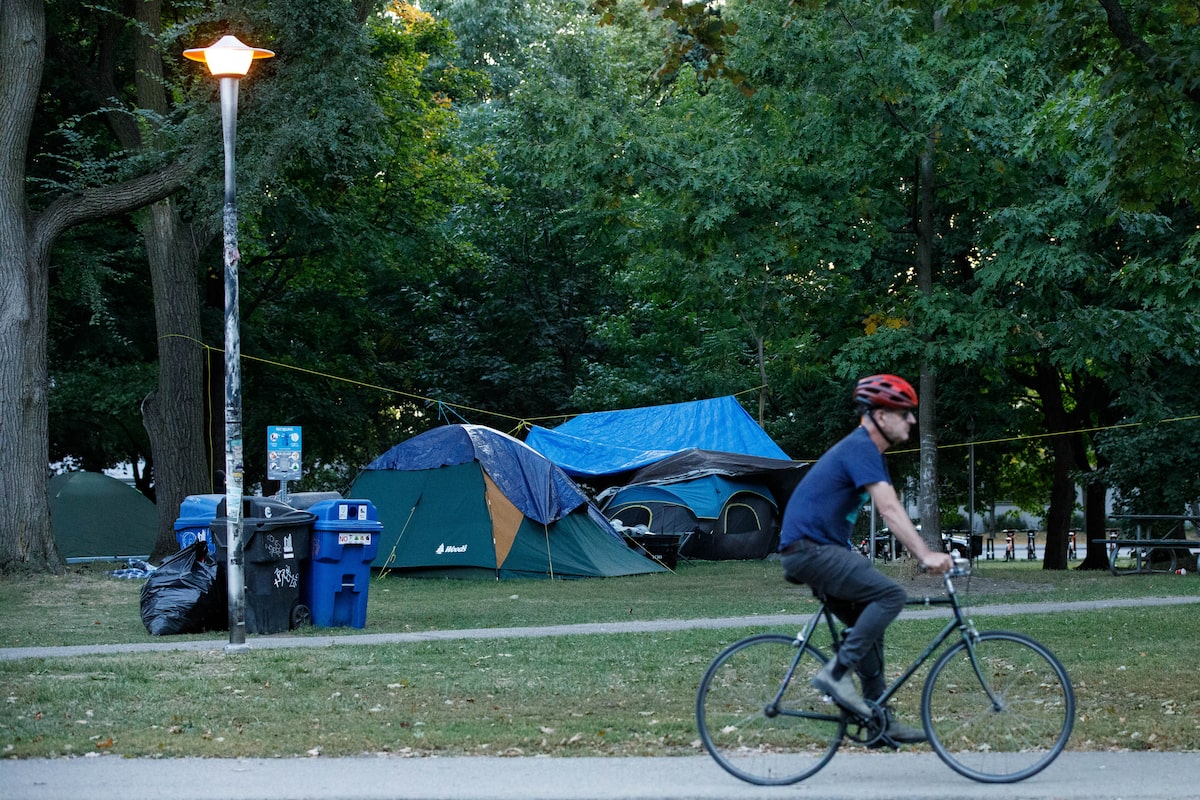
A man cycles past an encampment at Dufferin Grove Park in Toronto, in September.Alex Lupul/The Canadian Press
Delivery time
Re “An overdue reckoning at Canada Post” (Editorial, Nov. 22): Yes, there is an overdue reckoning at Canada Post: the inflated salaries of executives being at the top of my list. The public good seems to be at the bottom of their list.
We have few Canadian institutions left which serve as vehicles for national identity and connection, especially in smaller, more remote communities. Yes, there is competition, but a public corporation should have the advantage in that it need not consider the bottom line. Break-even should be the goal.
Canada Post can trim its top-heavy executives and rethink expenditures for warehouses and new vehicle fleets. It can charge marginally lower prices than the for-profit competition and still offer good-paying union jobs, which contribute to the tax base and offer a lifeline for rural Canadians.
Let’s stop being swept away by a capitalist approach. We should think about our people and how they can be served affordably, sustainably and fairly.
Peggy Smith Halifax
I find it facile at best to suggest that reducing service at Canada Post is “unavoidable,” when the federal government could choose to do what it always should have done: Renationalize our postal service and abandon this failed experiment of turning an essential service into a for-profit corporation.
Canada Post was inaugurated as a government department, Royal Mail Canada, soon after our country was founded, and it should continue into the future as one.
Dawn Crothers Hamilton
Public problems
Re “We have normalized delinquent, disorderly behaviour in our cities for too long” (Opinion, Nov. 22): This gets one thing right: We should not normalize the existence of encampments. As a society, it should be our responsibility to end homelessness.
But objections to social advocacy and the focus on law enforcement seem misplaced. Nobody wants more encampments, especially the people living in them. Calls to “clear” encampments, when there’s nowhere for people to go, feel simplistic.
We should press our governments to step up access to safe and dignified emergency shelters, stable and affordable housing and income supports that help people escape poverty. When we are dealing with an issue as serious as homelessness, we don’t have time for what I would describe as divisive rants that do little to solve the problem.
We want encampments to go away, because everyone should have a decent place to call home.
Elizabeth McIsaac President, Maytree; chair, City of Toronto Housing Rights Advisory Committee
At no point did I see mention of poverty, the housing crisis, the record levels of income inequality and lack of treatment for mental illness in this population, all factors which scholars know are root causes of unhoused issues in this city and country.
I believe what is happening is the logical outcome of decades of neoliberalization, the decline in spending on public health and public housing, the increasingly free-for-all nature of the rental market and growing societal inequality.
Serious structural investment and realignment of society, along the lines of what Finland has done on this matter, is what should be done to fix this issue and make our cities, park, and neighbourhoods safe and just places to live for all.
William MacGregor Toronto
You point to the central problem emerging from this persistent tolerance of dangerous and threatening public disorder in our cities: Citizens will likely continue to withdraw their consent and trust in their governments. The first order of good government is public order and safety, not chaos and danger.
During a recent bike ride through Ottawa, I was shocked to see a mother guiding her elementary-aged daughter into the street – with car traffic – to avoid a large gathering of homeless people who were blocking the sidewalk. They were simply trying to walk to school in the nation’s capital.
I see rampant open drug use throughout downtown, and public buildings and private businesses with their entrance ways blocked. These are not signs of a caring society, but rather one slipping into dysfunction.
When I informed city hall about the girl being forced to walk in the street, the response was silence. Shameful.
Mark Wolfgram Ottawa
Yes there is a problem, but I don’t think it is a lack of shelter spaces. It is rather a lack of shelter spaces equipped to accommodate the full range of people living in encampments: those with drug addictions, mental illnesses or criminal records, as well as any other conditions that may present themselves.
The availability of such facilities – a key requirement of judicial rulings involving closing encampment – would in all practicality no longer look like shelters, but would more resemble institutions. Likewise, the cost of running these institutions would be far more than running shelters.
Nevertheless, that is an expense that we now face, perhaps along with acceptance that the decision to close these same institutions in earlier decades was a big mistake.
George Parker Cobourg, Ont.
In a word
Re “How opioid deaths are hollowing out the construction industry” (Report on Business, Nov. 22): The research and storytelling are compelling, hammering home the economic and social impact of so many people in the trades dying preventable, substance-related deaths.
I hope in future reporting on this topic that you adhere to advice regarding language and stop using the word “addict.” In Mindset: Reporting on Mental Health, it is stated:“As with any disease or disorder, putting the person ahead of the ailment should be routine. People are much more than their disease … we should not label them alcoholics or addicts.”
So for future articles, please use the phrase “people who use substances.” It will help curb stigma.
Lorna Thomas Co-founder, Moms Stop The Harm; Edmonton
Stay in touch
Re “Why Canada’s roadways are studded with cellphone ‘dead zones’ ” (Nov. 22): I’m reminded of historian Charlotte Gray’s fascinating account of the Klondike Gold Rush in the late 1800s.
In her 2010 book Gold Diggers: Striking It Rich in the Klondike, she notes that Dawson City had relied on dog sleds headed south, laden with hundreds of pounds of letters destined for loved ones and business associates. If the sled happened to plunge through the ice (which did happen), then those hundreds of “calls” were, so to speak, “dropped.”
Being the father of three far-too-adventurous children whose work and hobbies often take them far off British Columbia’s beaten path, I am thankful for the wonders of modern cellphone technology, when it works.
How the times, and our levels of expectation, have changed.
Tom Bergen Squamish, B.C.
Letters to the Editor should be exclusive to The Globe and Mail. Include your name, address and daytime phone number. Keep letters to 150 words or fewer. Letters may be edited for length and clarity. To submit a letter by e-mail, click here: letters@globeandmail.com
[ad_2]
Source link