Royal Mail and DPD invest in big electric trucks
[ad_1]
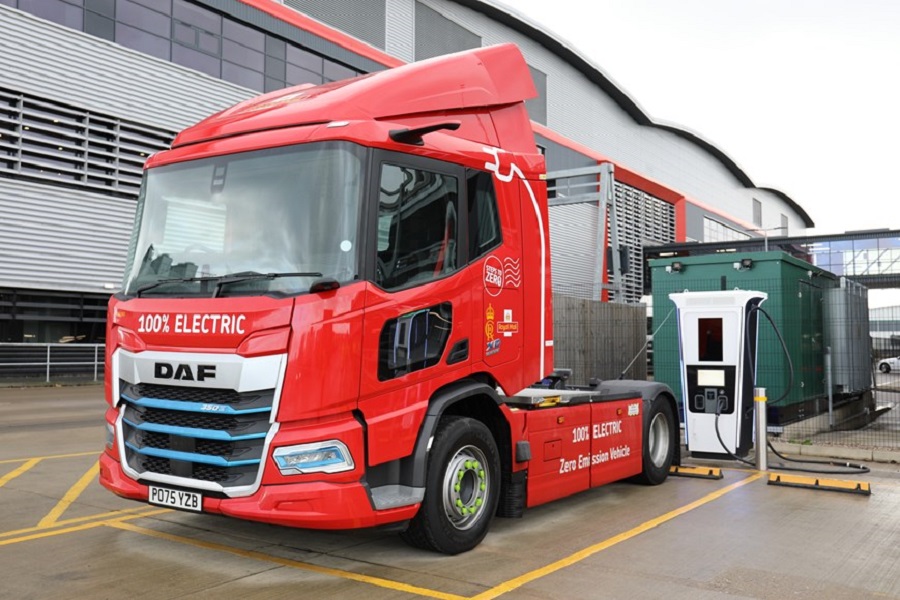
UK parcel carriers Royal Mail and DPD UK are ramping up their investments in heavy-duty electrification as the first wave of electric HGVs (eHGVs) enters operations, accelerating their nationwide zero-emission freight plans.
Royal Mail has begun deploying its new fleet of 42-tonne battery-electric DAF trucks at key parcel hubs, while DPD has launched a long-term trial of the Mercedes-Benz eActros 300 lowliner to test the technology in a full operational environment.
Together, the projects underline the rapid shift underway in the UK freight sector as operators prepare for large-scale rollouts over the next two years.
eHGV operations begin at Royal Mail
Royal Mail has rolled out eight DAF XD 350E 42-tonne eHGVs at its Midlands and Northwest parcel hubs in Daventry and Warrington, marking the postal operator’s first move into electrified long-distance trunking.
The vehicles, which have a manufacturer-stated range of up to 500 zero-emission kilometres, will be used continuously on “middle-mile” routes linking parcel hubs with large mail centres.
Each truck is paired with ABB’s T360 high-power chargers, enabling rapid top-ups of around 60 miles of range in under 15 minutes. Royal Mail said the new capacity would significantly cut emissions across its high-volume inter-hub network while providing cost savings over time by replacing diesel with lower-cost electric operations. The company expects the initial eight vehicles alone to save around 1,000 tonnes of carbon a year.
Laying the groundwork
Nick Dunn, Royal Mail’s National Distribution and Fleet Director, described the deployment as a major milestone for the organisation’s Net-Zero strategy. “Introducing electric HGVs into our network is a major milestone in decarbonising our operations and achieving our Net-Zero target,” he said, adding that the first phase would lay the groundwork for wider integration of eHGVs nationwide.
Royal Mail already runs the UK’s largest electric last-mile fleet, with more than 7,000 battery-electric vans operating from depots powered exclusively by renewable electricity. Electrifying heavy trucks is the next step in the company’s plan to maintain its position as “the UK’s greenest parcel operator” and reach Net Zero by 2040.
New high-power charging network
The Royal Mail rollout has been accelerated by its involvement in Electric Freightway, an advanced charging network specifically designed for heavy-duty trucks. Led by sustainable energy specialist Gridserve, the initiative is backed by over £100 million in investment, including £62.7 million of UK Government funding.
Electric Freightway aims to build the country’s most extensive high-power public charging network for eHGVs, with more than 200 chargers of up to 350 kW planned and infrastructure to support over 140 electric trucks. Royal Mail has already installed high-speed chargers at its Daventry and Warrington hubs as part of the scheme.
The project forms part of the UK’s Zero Emission HGV and Infrastructure Demonstrator (ZEHID) programme. The government-backed initiative – funded with up to £200 million through March 2026 – will support nearly 300 heavy battery-electric and hydrogen HGVs and more than 70 public and depot-based infrastructure sites.
DPD trials electric Mercedes-Benz eActros
Alongside Royal Mail’s launch, DPD has confirmed that it will run a long-term operational trial of the Mercedes-Benz eActros 300 lowliner. The carrier will deploy the truck on a live customer route to assess real-world range, payload performance and charging requirements under typical overnight trunking conditions.
The lowliner specification is key for DPD, allowing the truck to haul its high-capacity double-deck trailers – an essential component of its long-distance network. Double-deck trailers enable the business to reduce the number of HGVs on the road by maximising parcel volumes per journey, making compatibility with electric tractors essential for future emissions reductions.
The eActros 300’s three-pack 336 kWh battery system provides a range of up to 220 km. DPD plans to charge the vehicle using its existing 50 kW depot chargers, currently used for electric vans, during periods of natural downtime. The company will use the trial to understand how far its present electrical infrastructure can support a future electric trunking fleet without significant upgrades.
Tim Jones, Director of Marketing, Communications and Sustainability at DPDgroup UK, said the trial is designed to be “as realistic as possible,” including representative loads and operating conditions. He added that evaluating performance across changing seasons would give the company “valuable insight into how we can maximise our current charging infrastructure within our transport department’s operation.”
DPD builds on biofuel transition
DPD operates more than 1,600 HGVs in the UK, the majority of which currently run on hydrotreated vegetable oil (HVO) fuel, delivering an emissions reduction of up to 83% compared to diesel. The company sees electrification as the next stage in its roadmap toward Net Zero by 2040 – a target fully validated by the Science Based Targets initiative (SBTi).
The parcel carrier has already transformed its last-mile operations, with 35% of its UK van fleet now battery-electric. In November 2023, the company opened its all-electric London Docklands depot, enabling fully zero-emission deliveries across the capital. DPD reports that it reduced its overall emissions by 47.5% by the end of 2024 compared with its 2020 baseline, keeping it on track for its group-wide Net Zero commitment.
[ad_2]
Source link