Related Articles



Royal Mail, the official postal service for the UK, unveiled its Christmas 2025 stamps featuring scenes from the Nativity and ignited an online controversy. The collection – illustrated by award-winning British artist Paula Doherty and depicting figures like the Archangel Gabriel, Mary, Joseph, Jesus, the shepherds, and the wise men – has been praised for its elegant artwork using styles such as inlaid marble, enameling, marquetry, and collage. However, it has also drawn criticism from those who questioned the artistic interpretation, specifically suggesting the imagery was “Making them look Muslim.”
What is the Controversy?
The debate overtly centers on the depiction of Mary wearing a head covering, which some critics mischaracterize as drawing from Islamic religious aesthetics such as a hijab, but it’s also easy to see the references to the non-white skin color.
Comments from X:
“I’m sure, in an age where Anne Boleyn is black somehow, this is out of innocent desire to portray things with historical accuracy. Definitely not just endless antiwhite propaganda.”
“Another attcak [attack] on Christmas & Christians!”
Others, such as a Facebook group identifying as traditional Catholic, welcomed the stamps’ designs, “How wonderful!! The tide is turning and the United Kingdom is returning back to her Christian roots,” while simultaneously correlating it to the racial tensions and anti-immigration protests that have been on the rise in the UK.
Statements disputing the inanity quickly emerged, pointing out the historical and iconographic reality of Mary’s attire. As Mubin Shaikh, Interventionist for Parents for Peace and Editor-at-Large for the Intervention vertical at Homeland Security Today, pointed out, depictions of Mary have consistently shown her head covered for centuries.
“This British stamp is making the rounds because folks forgot Mary, the mother of Jesus, was from a Jewish family and would have covered her head in a similar manner,” Shaikh stated. “Nor is this some kind of ‘pandering’ to Muslims: ancient depictions of Mary, long before Islam, have her covered the same way.”
Understanding the Historical and Biblical Context to these Depictions
Ensuring the designs were faithful to Biblical accounts, known historical and cultural facts, and artistic tradition, Royal Mail consulted with theological and arts experts. These included Professor Andrew Davison, Regius Professor of Divinity at the Faculty of Theology and Religion from University of Oxford and Professor Ben Quash, Professor of Christianity and the Arts at King’s College London.
The Bible – neither the Old Testament nor the New Testament – provide much in the way of physical descriptions, except for some references that ancient Israelites had a Middle Eastern appearance, or David was “ruddy,” for example. The Quran does not provide much in the way of physical descriptions either. Scholarly consensus affirms the historical and cultural context that supports the stamps’ depictions:
- Middle Eastern and Jewish: Mary was a young Jewish woman from Nazareth in Galilee (now Northern Israel) during the Second Temple period, born roughly 2,000 years ago. She would have spoken Aramaic and likely Hebrew.

Computerized reconstruction by forensic anthropologist Richard Neave, working from actual skulls found in Galilee, for the BBC documentary Son of God. Neave did not claim it was Jesus’s face, only that it was a model of a typical Galilean Semite man for that same time period. (Source: BBC) - No one knows exactly what Jesus or Mary looked like, but the portrayal as white European was an evolution of Western trends not facts. Forensic anthropology was used by medical artist Richard Naeve in 2001 to reconstruct what a Jewish Galilean face likely looked like, which was much more representative of Middle Eastern genetics.
- Head Covering as Modesty: In 1st-century Judea, it was customary for married Jewish women to cover their hair when in public as a sign of modesty and piety. Many Roman women also covered their hair, especially those from the upper class. Islam and the revelations of the Quran, and thus its associated head coverings, did not begin until approximately 600 years after the destruction of the Second Temple.
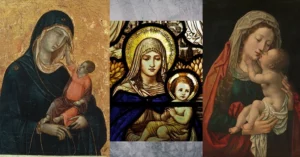
- Christian Iconography: Across much of Christian art and iconography, particularly in the Eastern Orthodox tradition, the Virgin Mary is almost universally shown with her head and often shoulders covered by a veil or maphorion, symbolizing her humility and devotion.

L to R: Madonna and Child, Duccio di Buoninsegna, c. 1290–1300, Metropolitan Museum of Art, New York City; stained glass of Mary and Jesus, Davenham Church, Cheshire; The Virgin and Child, Bernard van Orley, c. 1520-1530, Rijksmuseum
The controversy also highlights the varied interpretations of Mary and Jesus:
- Mary in Islam (Mariam): Mary (Mariam (مريم) in Arabic) is highly revered in Islam as a righteous and holy woman. She is the only woman explicitly named in the Quran and to have an entire chapter (Surah Maryam) named after her. Muslims believe the birth of Jesus was a miraculous event through the will of God, not that he was the son of God.
- Jesus (Isa) in Islam: Muslims regard Jesus as a great prophet and the Messiah (Masih). The Quran was revealed to the Prophet Muhammad approximately 600 years after Jesus’s time, but Muslims believe Mary and Jesus’s early followers were monotheists who believed in the one God (Allah).
- Jesus in Judaism: Judaism has no one, single view on Jesus – whether he was a rabbi or teacher, for example – only that he was a Jewish man who lived under the Roman Empire and was not the Messiah.
- In Christianity: It emerged as a separate religion in the centuries following his death, and relied on the belief that Jesus was resurrected, the “Son of God” and the promised Messiah. Mary, as the mother of Jesus, is referred to as “Mother of God” and the “Blessed Virgin Mary,” and often the subject of intercessory prayers.
In light of these facts, the artistic depiction of Mary’s head covering and the skin tone of the figures on the new stamps is not an adoption of Islamic aesthetics, but a historically grounded rendering of the figures central to the Nativity narratives.
Source link