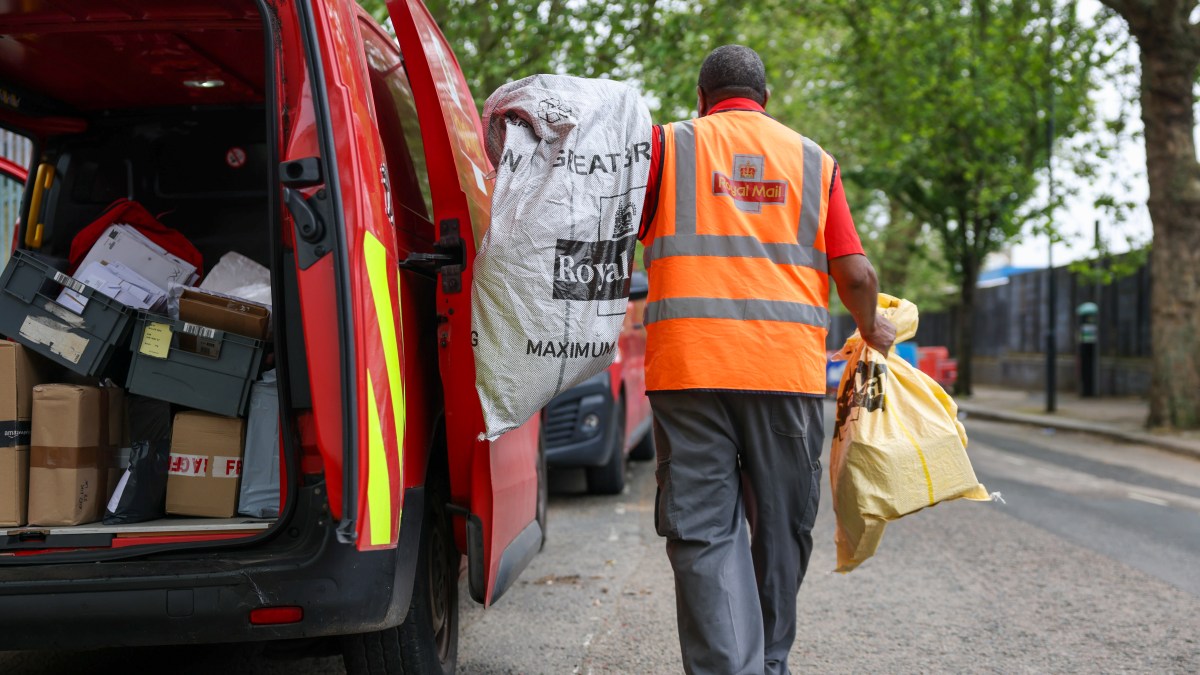
Royal Mail fined £21m by regulator for poor performance
[ad_1]
The UK’s media and telecoms regulator has fined Royal Mail for delivering millions of letters late, issuing its largest penalty to date for the delivery group and the third-largest fine in the watchdog’s history.
Ofcom said it was fining Royal Mail £21 million because it fell “well short” of targets for first and second class mail and said “people aren’t getting what they pay for when they buy a stamp”.
It ordered the business to “urgently publish — and deliver — a credible improvement plan” or face further fines and criticised Royal Mail’s alleged “empty promises” of improvement.
• Royal Mail achieves first annual profit in three years
The regulator said that in the 2024-25 financial year 77 per cent of first class mail and 92.5 per cent of second class mail were delivered on time, against targets of 93 per cent and 98.5 per cent, respectively.
The fine is the third penalty from Ofcom for Royal Mail in recent years for poor delivery performance, after it fined the company £5.6 million in 2023 and £10.5 million in 2024.
Ian Strawhorne, director of enforcement at Ofcom, said: “Millions of important letters are arriving late, and people aren’t getting what they pay for when they buy a stamp. These persistent failures are unacceptable, and customers expect and deserve better.
“Royal Mail must rebuild consumers’ confidence as a matter of urgency. And that means making actual significant improvements, not more empty promises. We’ve told the company to publicly set out how it’s going to deliver this change, and we expect to start seeing meaningful progress soon. If this doesn’t happen, fines are likely to continue.”
Ofcom concluded that Royal Mail had failed to provide an acceptable level of service without justification and took insufficient and ineffective steps to try and prevent this failure.
The fine, which will be passed to the Treasury, was reduced from £30 million in light of Royal Mail’s admissions of liability and agreement to settle the case.
Royal Mail is owned by International Distribution Services, which was taken private after its takeover by Czech billionaire Daniel Kretinsky, who also controls the owner of Allwyn, the operator of the UK National Lottery.
Ofcom said it considered the “harm suffered by customers” and the fact that the delivery group had breached its obligations in three consecutive years.
• Royal Mail delivers extra cash to help train apprentices
The regulator noted that an improvement plan set out by Royal Mail for the last financial year had “not materialised”. The group has missed delivery targets for at least seven years. The regulator did not levy any penalties on Royal Mail during the pandemic.
“This is unacceptable, and we have told Royal Mail it must urgently publish and implement a credible plan that delivers significant and continuous improvement. Without this, we are likely to continue to see financial penalties as both necessary and appropriate,” Ofcom warned.
In its last financial year, the group returned to profitability, having made a loss of £348 million in 2023-24 and £419 million in 2022-23.
The so-called universal service obligation (USO) regulates deliveries across the UK for the same price. In July, the regulator made changes to this, including the removal of a requirement on Royal Mail to deliver second class letters six days a week, allowing it to deliver such letters on alternate weekdays.

The company has a universal service obligation
ALAMY
Royal Mail acknowledged the regulator’s decision and said the pilot changes it has implemented to its universal service model have shown positive results.
“We acknowledge the decision made by Ofcom today and we will continue to work hard to deliver further sustained improvements to our quality of service,” it said.
“A key area of focus and investment has been the detailed work ahead of full implementation of our new delivery model, enabled by Ofcom’s changes to the universal service. This is critical to enable us to drive a step change in quality of service.
• Ofcom acting as ‘global censorship bureau’, US tech firms claim
“We have also implemented important changes across our network including recruiting, retaining and training our people, and providing additional support to delivery offices.
“Where we have piloted universal service changes, we can see that our model is working, with improvements in deliveries.”
[ad_2]
Source link