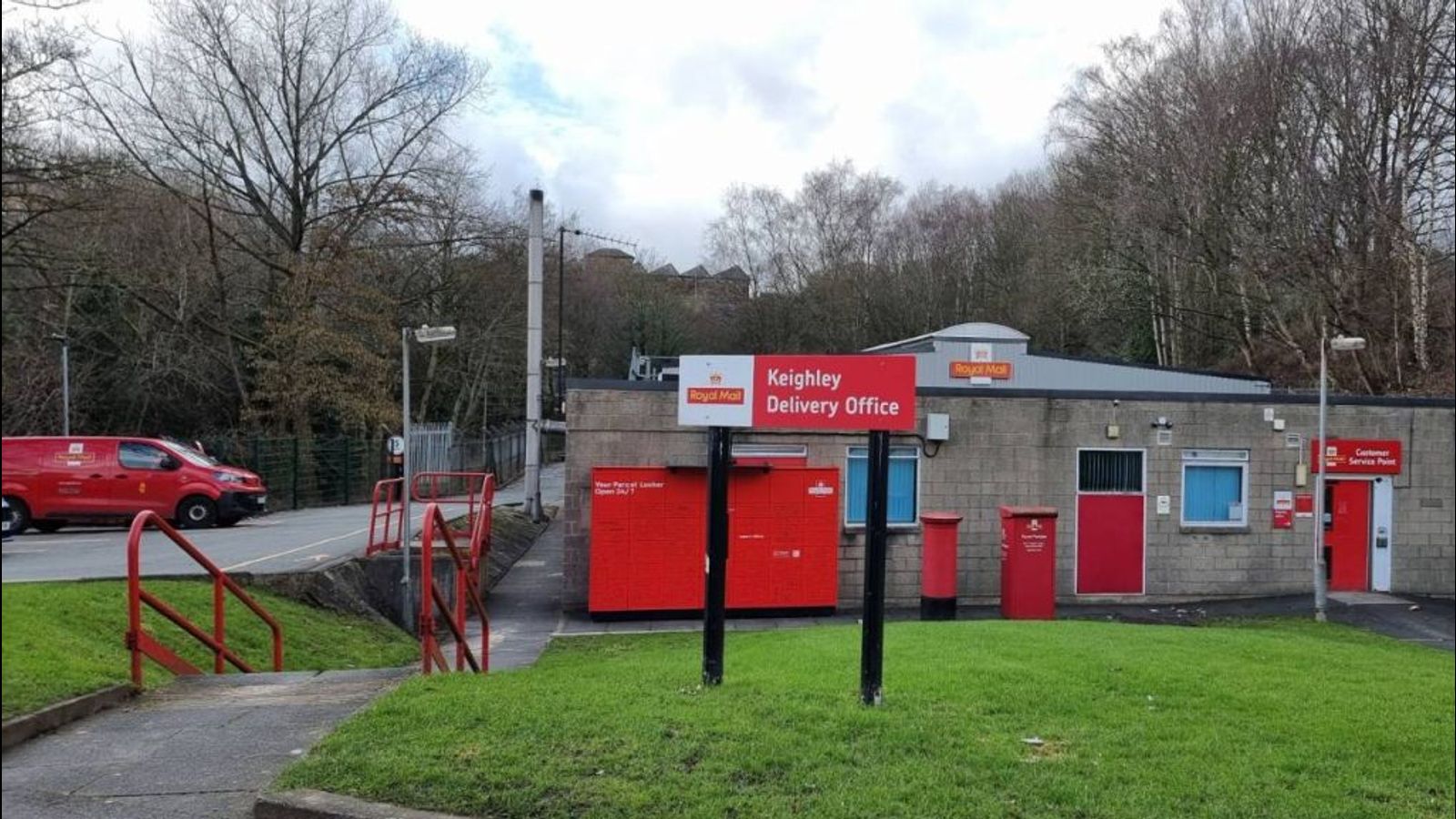
Royal Mail workers in Keighley, West Yorkshire: “They are trying to kill off the postal service”
[ad_1]
Postal workers at the Keighley delivery office in West Yorkshire spoke out against intolerable working conditions, mail backlogs and the collusion of the Communication Workers Union (CWU) leadership in enforcing Royal Mail’s restructuring agenda.
A campaign team from the Postal Workers Rank-and-File Committee (PWRFC) distributed its reply to the CWU’s Deputy General Secretary, “Communication Workers Union’s Martin Walsh opposes call for rank-and-file fightback at Royal Mail”. Delivery staff gave their insight into the situation.
“There are stacks of boxes of mail going back 10 days,” one said, including First Class letters.
Overtime was still in operation at the local Keighley unit in an effort to complete letter deliveries, as opposed to the de facto ban by management reported by postal workers in Sheffield, South Yorkshire, which led to delays of up to four weeks.
A postal worker who expressed sharp opposition to CWU officials’ role in the wrecking operation provided more extensive comments. Their name has been altered to protect against victimisation.
Ray said, “The CWU regional branch secretary, who is employed by Royal Mail but is on full-time release to do union work, came in earlier in the week and gave us a talk. He said it’s the people at the top of Royal Mail who are at fault, and there’s no point in us falling out with the managers here. Basically, he was saying we should just keep our heads down and do what we’re told. That’s what the union is saying.
“What he came in to tell us is to go along with Royal Mail flouting the statutory regulation to maximise their profits. It’s transparent. The statutory Universal Service Order, which they’ve had relaxed, they’re still flouting it. They’re still making us prioritise the tracked parcels, because that’s where the profit is.”
Royal Mail has repeatedly claimed that parcel prioritisation is justified on health and safety grounds, arguing that clearing parcels prevents hazards in already congested offices.
“That’s absolutely laughable,” Ray said. “The office is not fit for purpose as it is. It wasn’t when this manager came about five years ago, and it’s only got worse as they’ve put more tracked parcels onto us. Literally, you cannot move around down the aisles because they’re that close together.”
Ray described how the introduction of more parcel traffic and the movement of York cages (wheeled metal cages to transport mail and parcels) has worsened congestion. “Previously it was always based on sacks, so that was less of an issue. Now you can barely get up and down an aisle.”
As tracked items are prioritised, second-class letters accumulate in frames, creating heavier loads and worsening delays.
“Because they’re making us prioritise the tracked stuff, the second-class letters build up in the frame. So when we get it out, despite the fact that mail is supposed to be in decline, we’re taking heavier and heavier bags than we’ve ever taken. It builds up the mail so people get it late.
“It’s outside the USO—they’re not getting it alternate days, they’re not even getting it after five days in a lot of cases. It’s appalling.”
Asked whether management bonuses are tied to tracked performance, Ray said he did not know the exact structure but was clear that tracked metrics dominate. “I know it’s largely attached to tracked performance.”
Management has blamed service failures on sickness levels and adverse weather. He dismissed this as a cover story.
“Certainly burnout could be a factor,” Ray said, “But really they are lying about sickness. They lied about the backlog after Christmas. They lied about the weather affecting things. They come out with any old sh** just to tell the media. The letter problem is all over the country—it’s not just one office.”
He cited a recent memo encouraging workers to learn CPR (Cardiopulmonary Resuscitation) as indicative of management cynicism. “They make out it’s something for you, for your family and stuff like that. But what do you get? A load of free First Aiders in your workforce. It’s like a coded message saying this job is going to kill you, especially older workers.”
Above all, he expressed anger and distrust toward the CWU leadership.
“They’re just going to sell us out, aren’t they? When the branch secretary came in, he was saying it was the top of the union and the top of Royal Mail talking to each other, sorting out how they’re going to implement this Optimised Delivery Model, or the union’s version of it. I think it’ll just come along and happen, because they’ve got no fight in them at all.”
The union had already paved the way for inferior terms and conditions: “They’ve given people the impression that they can up their terms and conditions that the union allowed to exist in the first place by bringing us in off the strike.”
When it was argued that workers need to organise independently of the union apparatus to defend jobs and the postal service, Ray agreed. “Yes, absolutely. I think they’re trying to kill off the postal service. They want people to not have any confidence in it at all and therefore stop using it. So yes, I do agree that workers need to organise independently of the union.”
He pointed to how CWU fostered a sense of powerlessness among postal workers. “At the moment, I’m not getting the impression that people are ready for a fight. They seem to be resigned to things. But that’s in large part because of the union, the signals they’re giving us.”
The conditions described by Keighley postal workers are part of a nationwide restructuring drive aimed at transforming Royal Mail into a parcel-led logistics company, shredding the Universal Service Obligation and eroding secure, full-time jobs. The prioritisation of tracked parcels, the mounting letter backlogs and the worsening working environment are the result of the agenda pursued under Royal Mail’s new owners, billionaire Daniel Kretinsky’s EP Group.
The CWU official’s insistence at Keighley that workers “keep their heads down” and avoid confrontation with local management exposes the integration of the union apparatus as an arm of the company. The lower-ranking officials on full-time release do not act as representatives of workers at the coalface, but the minions of the bureaucracy led by Walsh to stifle resistance which could spark broader discontent.
The discussions at Keighley show that postal workers recognise the destruction of the letters service is not inevitable, but the result of conscious policy choices driven by profit.
Only through the building of rank-and-file committees, independent of the CWU bureaucracy, can postal workers unify across all delivery units, link up nationally with the 130,000-strong Royal Mail workforce, and with postal workers facing similar attacks internationally. This is what is required to mount a determined fight to defend jobs, conditions and the universal postal service as a public good.
We encourage postal workers to contact the PWRFC to break the isolation, share your experiences and organise a collective fightback.
[ad_2]
Source link