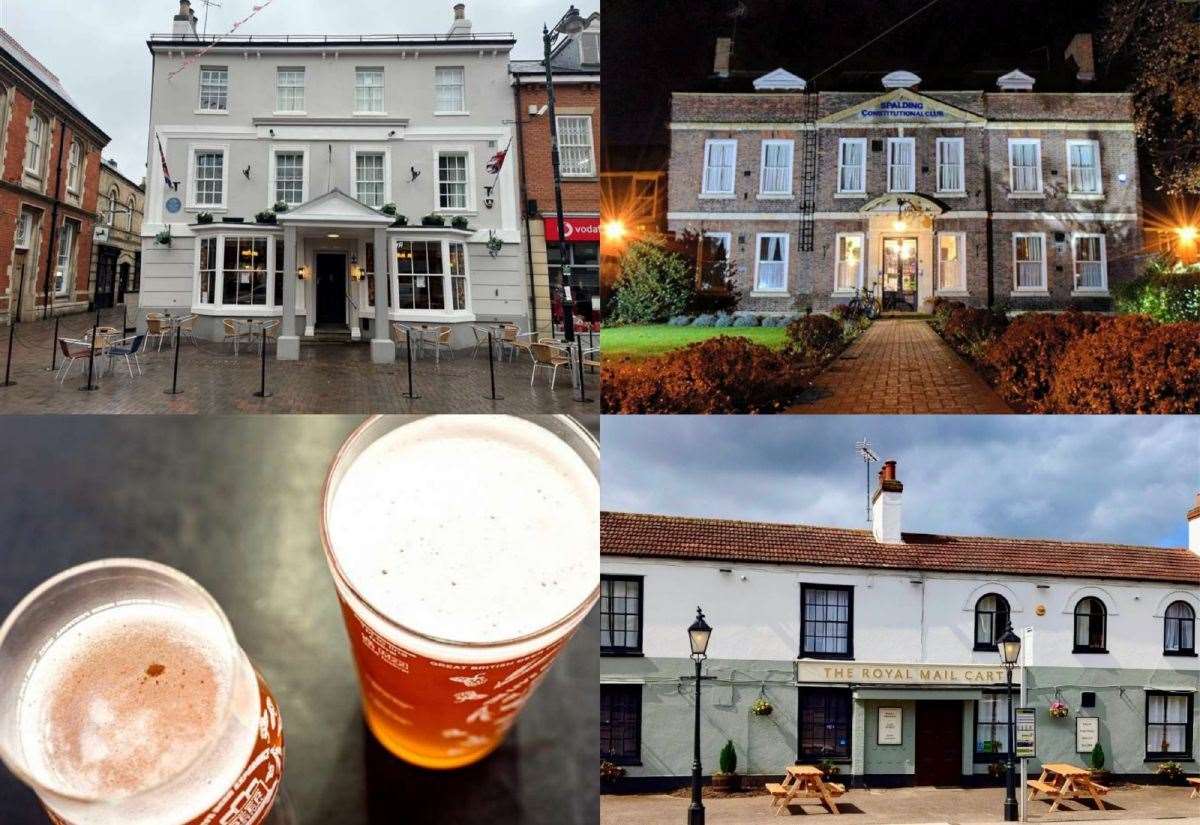
Spalding publicans from Red Lion Hotel, Royal Mail Cart and Consti Club speak out on government plans to scrap the need to promote alcohol licences
[ad_1]
Publicans say government licensing reforms would not help them — and that they feel decision makers ‘have completely lost sight of why pubs exist’.
Ministers have launched a consultation on licensing reform, which includes a proposal to axe the statutory requirement for alcohol licensing notices to be advertised in print local papers.
If enacted, the proposal in the current consultation — launched on October 9 by Prime Minister Sir Keir Starmer and Business Secretary Peter Kyle — would mean that plans to open a new pub or nightclub, or for an existing venue to change its opening hours, would no longer be publicised within local communities.

Pub managers in Spalding feel this is not the right way to help them — and argue there are other ways for venues to save money and remain buoyant in the face of hundreds of pubs closing across the UK this year.
Padraig Hughes, manager at the Royal Mail Cart, says he’s keeping an open mind about the proposal but added: “Tidy up the red tape around occasional late licences by all means — but don’t dress it up as a solution to the pub crisis, it’s not.”

Mr Hughes said: “The idea that simply extending hours will somehow revitalise pubs is, frankly, missing the point.
“I’ve seen it in Ireland too, the pubs that stayed open into the small hours were never the successful ones.
“The well-run houses that kept good time, closed when they said they would and maintained a bit of discipline were the ones that built loyal, happy customers.”

In recent times there have also been concerns about the gambling licenses in towns that have little or no support for addicts and planning matters being passed with no public scrutiny.
Mr Hughes said: “Licensed premises exist for a reason, to keep alcohol safe, controlled and social – not to encourage excess – and people actually like that structure.
“The mental health of a nation depends on people socialising in a healthy way, and pubs are arguably the best place for that.

“But governments have completely lost sight of why pubs exist.”
The government’s Licensing Taskforce – which made the initial recommendation to scrap alcohol licensing notices in local papers – was set up to review the Licensing Act 2003 which applies to England and Wales.
There’s also concern that this reform could lead to cutting the rules on other licensing matters — a particular problem in Lincolnshire where shops and off-licences have been raided after selling counterfeit products and where there’s concern over the impact of gambling establishments on communities with little or no support network for addicts.

Mr Hughes added: “If they really want to revive our high streets, then tax the likes of Amazon instead of the corner pub and shop.
“The decline of retail has hollowed out our towns – fewer shops means fewer people out and about,.
“Pubs thrive when towns thrive.”

Keith Copping, committee member at the ‘Consti Club’ in Spalding is in agreement with publicans who see this licence reform as a ‘waste of time’.
He said “The simple ways to save pubs from closing are to reduce VAT, National Insurance, duty on alcohol and business rates.
“There is no point in opening longer, it just wouldn’t be viable monetarily wise.
“The footfall in Spalding certainly wouldn’t warrant opening longer.”
Kirsty Berry, general manager at the Red Lion Hotel in Spalding feels there has been a decline in trade and a change in drinking habits, making late licences unnecessary.
She said: “I do not believe being open any longer would benefit pubs, and especially my business.
“We’re already open 14 hours per day and most weeknights we only have one or two people in the pub at 11pm, especially as we go into colder winter months when people want to be wrapped up at home.
“While I think making provisions such as live music easier would benefit us, nothing else here would.”
With mostly female staff, if the pub was to open after midnight there would be more costs for security.
She added: “Pubs are simply not late night venues.
“Even most nightclubs in recent years have found a drastic decline in trade which shows there is little call for late licenses.
“Plus the trend from millennials and gen Z are turning towards non-alcoholic drinks – I’ve never served so many non-alcoholic drinks as we do in the current climate.”
Independent research from OnePoll shows that local news media remains the primary source used by the public to access public notices, ahead of other sources such as social media, local authority websites, search engines, and printed mailouts.
NMA chief executive Owen Meredith said: “Pubs and local papers go hand in hand. They are community hubs, rooted in place, fostering connection, and acting as a glue that binds neighbourhoods together.
“Yet the government’s misguided proposals for secret alcohol licensing notices would damage local community cohesion by making decisions around hospitality venues less transparent, ultimately harming both pubs and local papers.”
What do you think? Post your comments below.
[ad_2]
Source link