What the Landmark Postal Workers Tribunal Means for the G…
[ad_1]
A cohort of postal drivers is taking legal action against a Royal Mail-owned courier service, arguing that they are entitled to workers’ rights on the basis that they’re wrongly classed as self-employed. As it currently stands, the 46 drivers bringing legal action against the company are classed as self-employed by eCourier. Their work is vital, working around the clock making deliveries which include transporting vital blood and tissue samples to and from NHS hospitals.
In turn, an employment tribunal is underway and set to be heard this year; their case argues that the company has wrongly categorised them as self-employed despite features of their work that they argue meet the threshold of worker status. The implications of this would confer statutory rights such as the minimum wage and holiday pay.
The main crux of their case, as argued by them, is that the level of control exercised over their work, the allocation of their labour, expectations regarding their availability, and output, does not constitute self-employment. UK employment law recognises three main statuses: employee, worker, and self-employed contractor. Gig-economy companies typically rely on the last category because genuinely self-employed people are excluded from most employment rights. But tribunals are not required to accept the label a company uses; they must look at the reality of the working relationship.
This begs the question: what is a worker? The Supreme Court’s 2021 decision in Uber v Aslam (won by the law firm which will preside over this case) is the key reference point. The court made clear that tribunals should focus on substance over form, especially where there is an imbalance of bargaining power. To decide this, a multi-stage test is typically applied:
- Control: Who decides how work is allocated, when it is done, and how performance is monitored?
- Personal service: Is the individual expected to do the work themselves, or can they freely send a substitute?
- Economic dependence: Is the individual really running a business of their own, or are they dependent on a single company for work?
- Integration: How far is the individual embedded into the company’s operations?
In the case of Uber v Aslam, drivers were found to be designated as workers because the company set fares, controlled access to work, imposed performance standards, and penalised drivers who did not accept enough jobs, even though contractual terms insisted they were independent contractors. The parallel in this case is that eCourier drivers argue that similar features are present here. They argue that the dichotomy between legally employed persons and the self-employed is made salient by centralised job allocation by a recognised employer, expectations regarding availability, and the reality that many drivers spend long sections of their shift unpaid.
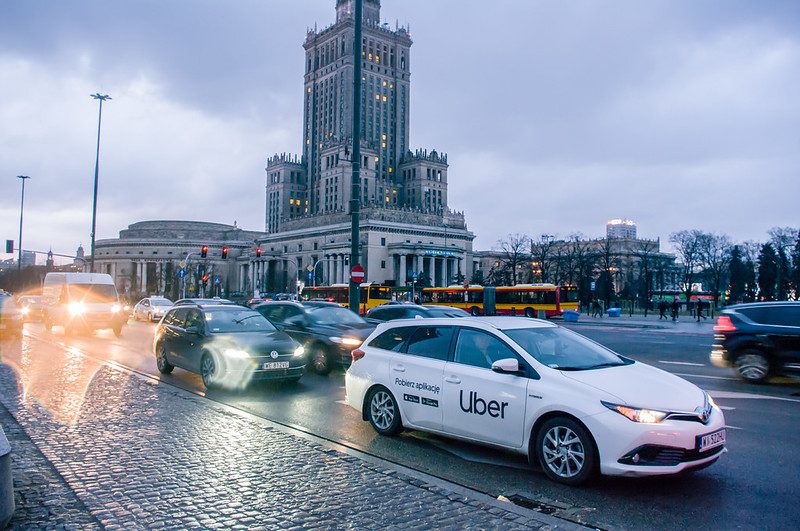
Image Credit: Konrad Krajewski
Speaking to the Guardian, one of the workers said: “I work 12-hour shifts, five days a week, but depending on how many jobs I get, I can take home less than the minimum wage. Sometimes, I’m sitting in the van for five or six hours on my shift without work. We have to pay our own vehicle rental, fuel, and tax. Most of my work is delivering patient samples to NHS hospitals. I want to see a change in how drivers are treated and I just want things to be fair.”
What does this mean for the public?
A case such as this highlights a tension in Britain’s current labour market. With the rise of the gig economy, cases like this have proven to be salient to the public interest: companies benefit from flexibility and low labour costs while risk and collateral are absorbed by workers. For the most part, the law’s response has been incremental and has operated on a case-by-case basis, relying on tribunals to pierce contractual semantics. This is why unions relentlessly argue the problem extends beyond misclassification and is rather a matter of systemic under-enforcement.
Until legal definitions shift, worker status will continue to be won through litigation rather than guaranteed at the outset. This may be achieved either via legislation or greater regulatory action. The union which primarily supports the claim in question is the Independent Workers Union of Great Britain. Speaking on the matter, its president, Alex Marshall, said: “This case highlights the government’s failure to tackle the deep injustice that runs through the gig economy.
While ministers promote the employment rights bill as a once-in-a-generation advance for workers, they continue to ignore the elephant in the room: gig economy companies are still being allowed to opt out of basic workers’ rights altogether. For employers who want to deny their workforce fair pay and protections, the gig economy remains wide open for business.”

Image: Prime Minister Keir Starmer at Number 10 Downing Street – Number 10 Downing Street / Lauren Hurley
Labour’s flagship Employment Rights Act 2025 set out to implement a seismic shift in labour relations and represents one of the most seminal interventions in the balance of class forces in decades. Implementing guaranteed hours rights for people on zero-hours or variable contracts and the expansion of statutory rights such as unfair dismissal protection, parental leave, and sick pay were among the many seminal shifts implemented in the bill.
However, these reforms benefit people classified as workers or employees, but crucially, merely changing entitlements doesn’t change where “self-employment” begins or ends in law. On that basis, these reforms layer on top of existing status law. If someone is held to be genuinely self-employed, they still will not automatically receive the privileges granted in the worker/employee rights guaranteed in the government’s new statute.
Thus, this tribunal is paramount; not only will it arguably set an ample precedent in labour relations and employment law for the foreseeable future, but it highlights the necessity for clearer employment classification if future governments wish for progressive employment rights to be effective. The baseline legal test for status remains unchanged, tribunals still analyse control, personal service, and mutuality to decide whether someone is a worker. That being said, the practical downside of being misclassified is now greater: the suite of rights available to workers/employees has widened and will continue to widen further as the Employment Rights Act is phased in.
Ultimately, employers face bigger potential liability if someone is found to be a worker rather than self-employed. If claimants have more to gain from status access than under the pre-Labour regime, then the necessity for stricter legal classification regarding employment is evidently an extremely high priority for the public interest and labour relations as a whole.
Featured Image via flickr (waterford_man)
[ad_2]
Source link